The ‘Bhamburda – Erandvan University’ of Pune

Some of you may have heard of ‘Bhamburda’ and ‘Erandvan’ areas of Pune. As the old Pune city grew, these ‘villages’ from across the Mutha river were added into the city limits, around 1920.
Today, the ‘Bhamburda’ area is referred to as Shivajinagar. ‘Erandvan’ still continues to be known as ‘Erandvan’ (or ‘Erandvane’) – this is the Prabhat Road/Karve Road/Deccan Gymkhana area. These areas, while new a hundred years ago, today represent the new center of Pune city and most Punekars and many visitors are well familiar with this.
But, have you heard of the ‘Bhamburda – Erandvan University’ located right here? It is one of the top Education, Research and Knowledge Clusters in the entire country. It consists of various top institutes in many diverse fields. Fields as diverse as Films, Journalism, Management, Oriental & Indology Research, Law, Politics, Economics, Sciences, Agriculture, Weather, Engineering and more.
This ‘university’ is located along a 2-3 km stretch, surrounded by hills and dense tree cover. And in the center of the city.
Sounds vaguely familiar? Well, even old Punekars have not heard of this ‘university’ – the reason being that it doesn’t ‘officially’ exist. At least not as a formal entity.
But it is very much there. Ultimately, what is a ‘university’? It is a place of learning and research across various domains – in a good environment, geographic proximity and good cross collaboration between various disciplines, and students and faculty staying nearby…right? All that exists here. And with a rich legacy that goes back over a hundred years.
So what is this ‘university’? Well, I am referring to the many great institutions located in Shivajinagar (old name Bhamburda) and Erandwane (old name Erandvan) in Pune. Quite a few of these were setup along an old road that goes along the Law College and Fergusson Hills, connecting Gokhale Road (Fergusson Road), with Karve Road. And some institutions a bit further away.
Today this road is split into two parts – Law College Road (Chiplunkar Road) and BMCC Road (Agarkar Road). But before the creation of the Senapati Bapat Road, this was one contiguous road. Only after the Senapati Bapat Road junction was created in the late 1960s, did we start identifying these as two separate roads.
This road spans through the old Bhamburda and Erandvan areas.
The first great institution to be established here, was the Fergusson College. The Deccan Education Society, founded by Tilak, Agarkar, Namjoshi and Apte established this college in 1885. In 1905, Gopal Krishna Gokhale built a bungalow nearby and his Servants of India Society was also setup here. Later in the 1930, this became the site of the Gokhale Institute of Politics & Economics. The Ranade Institute and the old ‘Aryabhushan Press’ are also located at one of end of the BMCC Road.
In 1917, a group of students of the great Indology scholar R.G. Bhandarkar established the Bhandarkar Oriental Research Institute. The present day Bhandarkar Institute Road didn’t exist then and was created a few years later.
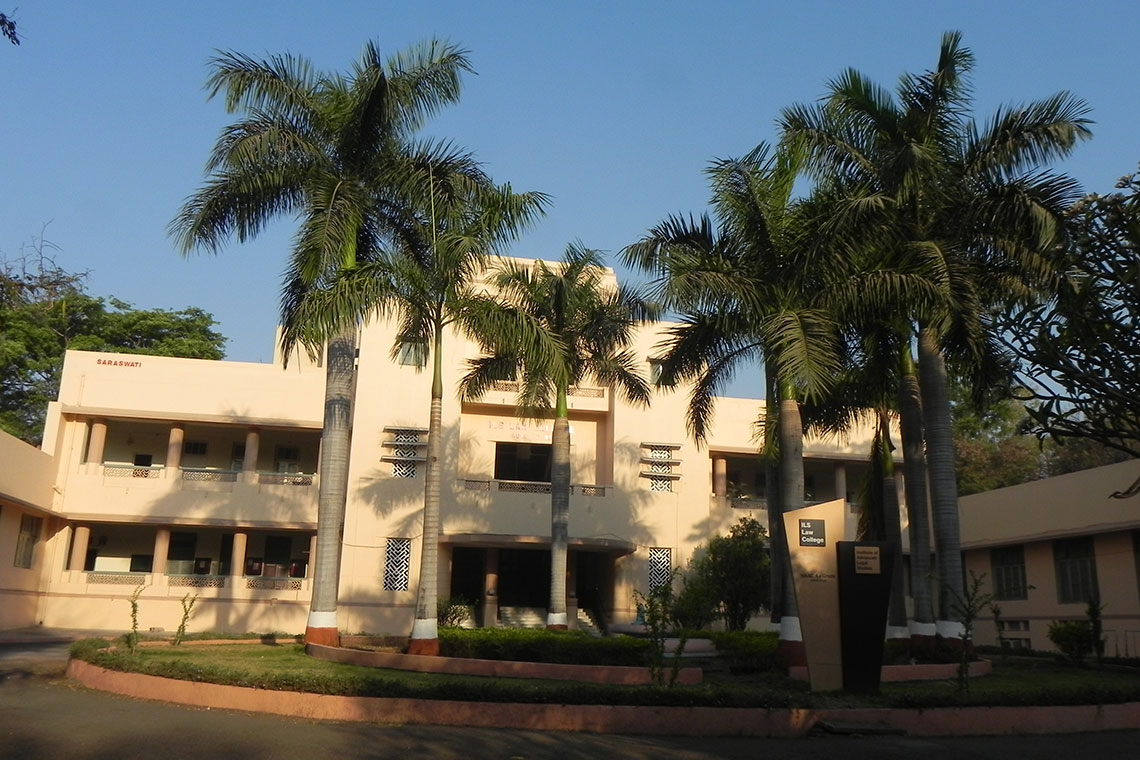
Right next to the Bhandarkar Institute, the Indian Law Society established the ILS Law College in 1925. A few hundred meters further down the road, one of Indian Cinema’s top studios – the Prabhat Studio was established in 1933. This studio produced some of India’s finest films in the 1930s, which won many international awards. The studio closed down in the 1948. Later, in the 1960s – the Films & Television Institute of India was established in this campus.
At one end of this road (area near present day intersection of Law College Road and Karve Road), Maharishi Karve established the first women’s university of the country in 1916 – the SNDT Women’s University.
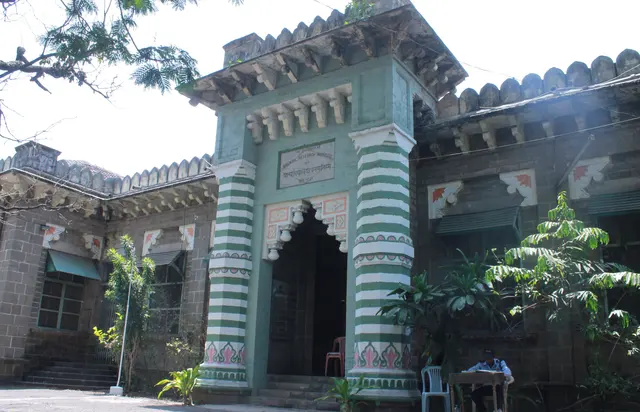
Barrister Jayakar built a large bungalow across from the ILS Law College in the 1930s. Note that he was the first Vice Chancellor of the University of Poona, which was established in 1948. In fact, the ‘University of Poona’ (today’s SPPU) was started in the Bhandarkar Institute campus in 1948, and it shifted to its present campus in 1949. After the death of Barrister Jayakar, his bungalow was converted to the National Film Archives.
Meanwhile in 1940s, the BMCC College of Commerce was setup right next to the Gokhale Institute. The Agharkar Institute (focused on plant, animal and microbial sciences) came up in the neighbourhood in the 1950s.
Fast forward to 1970s and the Symbiosis Campus started taking shape on Senapati Bapat Road, at the foothills of the ‘Khind’ on the new Senapati Bapat Road. What started as a hostel for foreign students, 50 year ago has now become one of the largest private deemed universities in the country. While Symbiosis now has dozens of campuses in Pune and many more all over the country – the original campus and the ‘main campus’ continues to be right here.

A bit further beyond this 2 km stretch of road, but still very much in Bhamburda area is the College of Engineering, Pune – the 2nd oldest engineering college in the country, which was established in 1854! It is one of the top engineering colleges in the country. Nearby is the ‘Shimla Office’ – the massive Indian Meteorological Department (IMD) building, built in the 1920s. It used to the national head quarters of the IMD in the 1930s and 40s. Close by, at the intersection of Fergusson College Road and Ganesh Khind Road is one of the oldest dedicated agriculture (if not the oldest) colleges in the country – established around 1905. And there are many more colleges and institutions in the area such as the Abasaheb Garware College, Modern College and more.
As I said earlier all these institutes are not formally part of one single official organization or university – but some collaboration/knowledge exchange between them, does exist. Of course, it needs to improve a lot more and organizational barriers sometimes impede this process. But there are some advantages as well, of being distributed.
Over the past many decades, some of these institutes have moved up, while some have slipped down in their respective areas of work. Some are attempting to reinvent themselves. It’s a dynamic scenario.
Over the past few decades – a similar independent set of institutions cluster has come up along the Pashan, Baner Roads – past the University of Pune (SPPU) campus. I will describe these in a separate article.
Here’s hoping that the ‘Bhamburda Erandvan’ distributed, loosely coupled ‘university’ continues to excel in the 21st century!
‘वसंत व्याख्यानमाला’ (Vasant Vyakhyanmala- Spring Lecture Series) – A Great 144 Year Tradition
I had written an article about this great 144 year tradition few years back, and I am reproducing a version of that below. I have also included the schedule for this year’s lecture series (click on the images at the end of this article). Do try to attend as many lectures as you can! Do note, many of the lectures are in Marathi (a few are in English). Please use the hash tag: #VasantVyakhyanmala or #वसंतव्याख्यानमाला when you tweet about these lectures.
This year’s schedule covers a series of topics including politics, defense, governance, history, music, literature, technology and many more. Good line up of speakers this year with a variety of different experience. (See detailed schedule below).
Some of the interesting speakers to look forward to, over the next 30 days: Dr. Anil Kakodkar, Prof. Seshrao More, Sunil Deodhar, Dr. Suhas Palshikar, Dr. Madhav Chitale, Dr. Madhav Godbole, Girish Kulkarni, Hon. Minister Suresh Prabhu, and more.
___________________
(blog-post from 2012 about Vasant Vyakhyanmala)
In recent years, TED and TEDx events are getting quite popular. They do a great job of presenting ideas from various experts and thought leaders. The first TED India event was very well received and many TEDx events have been held in various cities in India over the past year.
But did you know that an event similar in concept, but covering a broader range of topics, has been going on in Pune for 136 years! The great tradition of the ‘Vasant Vyakhyanmala’ (translation: ‘Spring Lecture Series’) was started by Justice M.G. Ranade in 1875. The idea was to present a variety of lectures, across various topics to the people. In those days, newspapers were in their infancy (Kesari had not yet started) and live lectures were the most effective medium for knowledge transfer.
Since the 18th century Peshwa era, Pune has always been a center of knowledge and education. Post the fall of the Maratha Empire in 1818, Pune city witnessed a tough period lasting for a few decades. The city’s economy was in shambles. Many scholars and learned experts left the city. Things started to improve towards the later half of the 19th century, under visionary leaders such as Justice Ranade (and later on Lokmanya Tilak).
Ranade, Tilak and other leaders of that period clearly saw the value of ‘Information’. The citizens had to be educated and informed. The Vasant Vyankhyanmala initiative was born out of the need to disseminate information and create awareness. Justice Ranade delivered the first lecture in 1875 in English. Over the years though, most lectures have been delivered in Marathi. Through its rich 137 year history, there have been very rare occasions, where the series had to be cancelled. For many years, the Vasant Vyankhyanmala was held at Hirabag and Belbag. It has been held at its present venue – Tilak Smarak Mandir, for many decades. Today, this series covers wide ranging topics such as Culture, Arts, Economics, Science, Health, Governance, History, etc.
While I have followed this lecture series over the years through media coverage, this was my first year attending it. The event format and the organization was very good. The only negative in my view was the number of attendees (probably less than 500). In the pre-independence era, 1000s attended these lectures. Today, there are many other media sources for getting information, but an informative and thought-provoking live lecture is still a very powerful source. If you are in Pune, you should definitely try and attend at least some of these lectures, over the next 3 weeks. The lectures are virtually free to attend (Single lecture ticket costs Rs 5 and the season ticket is Rs 100).
There is a need to get the word out regarding Vasant Vyakhyanmala. More media publicity and social media presence will definitely help. I do hope that in the next few years, this great tradition that started in 1875 will continue to thrive, and reach much bigger audience.
______________________________
Schedule* for the 144th Vasant Vyakhyanmala
(* Schedule is subject to change)


‘वसंत व्याख्यानमाला’ (Vasant Vyakhyanmala- Spring Lecture Series) – A Great 143 Year Tradition
The 143rd edition of the month long ‘Vasant Vyakhyanmala’ (Spring Lecture Series),starts April 21 at Tilak Smarak Mandir. This lecture series was originally started by Justice Mahadev Govind Ranade in 1875.
I had written an article about this great 143 year tradition few years back, and I am reproducing a version of that below. I have also included the schedule for this year’s lecture series (click on the images at the end of this article). Do try to attend as many lectures as you can! Do note, many of the lectures are in Marathi (a few are in English). Please use the hash tag: #VasantVyakhyanmala or #वसंतव्याख्यानमाला when you tweet about these lectures.
This year’s schedule covers a series of topics including politics, governance, history, civic issues, music, literature, healthcare and many more. Good line up of speakers this year with a variety of different experience.
Some of the interesting speakers to look forward, over the month: Former Chief Minister of Maharashtra, Prithviraj Chavan, Mayor of Pune, Mukta Tilak, Dr. Madhavrao Gadgil, Pramod Choudhari and many more.
___________________
(blog-post from 2012 about Vasant Vyakhyanmala)
In recent years, TED and TEDx events are getting quite popular. They do a great job of presenting ideas from various experts and thought leaders. The first TED India event was very well received and many TEDx events have been held in various cities in India over the past year.
But did you know that an event similar in concept, but covering a broader range of topics, has been going on in Pune for 136 years! The great tradition of the ‘Vasant Vyakhyanmala’ (translation: ‘Spring Lecture Series’) was started by Justice M.G. Ranade in 1875. The idea was to present a variety of lectures, across various topics to the people. In those days, newspapers were in their infancy (Kesari had not yet started) and live lectures were the most effective medium for knowledge transfer.
Since the 18th century Peshwa era, Pune has always been a center of knowledge and education. Post the fall of the Maratha Empire in 1818, Pune city witnessed a tough period lasting for a few decades. The city’s economy was in shambles. Many scholars and learned experts left the city. Things started to improve towards the later half of the 19th century, under visionary leaders such as Justice Ranade (and later on Lokmanya Tilak).
Ranade, Tilak and other leaders of that period clearly saw the value of ‘Information’. The citizens had to be educated and informed. The Vasant Vyankhyanmala initiative was born out of the need to disseminate information and create awareness. Justice Ranade delivered the first lecture in 1875 in English. Over the years though, most lectures have been delivered in Marathi. Through its rich 137 year history, there have been very rare occasions, where the series had to be cancelled. For many years, the Vasant Vyankhyanmala was held at Hirabag and Belbag. It has been held at its present venue – Tilak Smarak Mandir, for many decades. Today, this series covers wide ranging topics such as Culture, Arts, Economics, Science, Health, Governance, History, etc.
While I have followed this lecture series over the years through media coverage, this was my first year attending it. The event format and the organization was very good. The only negative in my view was the number of attendees (probably less than 500). In the pre-independence era, 1000s attended these lectures. Today, there are many other media sources for getting information, but an informative and thought-provoking live lecture is still a very powerful source. If you are in Pune, you should definitely try and attend at least some of these lectures, over the next 3 weeks. The lectures are virtually free to attend (Single lecture ticket costs Rs 5 and the season ticket is Rs 100).
There is a need to get the word out regarding Vasant Vyakhyanmala. More media publicity and social media presence will definitely help. I do hope that in the next few years, this great tradition that started in 1875 will continue to thrive, and reach much bigger audience.
______________________________

Vasant Vyakhyanmala 2017 – Schedule

____
Pune Metro Rail – Need to plan future corridors looking at requirements for 2030 and beyond
After nearly a decade long delay, it looks like the Pune Metro Rail project is finally going to see the light of the day. The PIB (Public Investment Board) approval came in last week, and the final approval from the Central Cabinet is expected later this month. Following this approval, the official launch of the project is expected soon thereafter.

Pune Metro Region (image via Google Maps)
Like with many infrastructure projects in Pune (airport, ring road, etc.), the Metro too is many years behind schedule. Today, the Pune metropolitan region has a population of over 6 million, and this is expected to approach 10 million in the next two decades. From an economy perspective, the Pune region will be among the top 5/6 metros in the country by 2030 – with major economic activity in both manufacturing and services.
At present, Pune has one of the worst public transit systems, among large cities in India. The percentage of private vehicle ownership is among the highest in the country. The city is adding over 1,000 new vehicles on the road each day! Big traffic jams, a rarity in Pune not long ago, are becoming the norm. With each passing year, they are getting worse. Improving public transportation is a critical need for the city.
Public transport needs to be enabled through multiple modes: Suburban/Light Rail, Metro Rail, BRT, Bus Service, Mini-Bus Shuttles, Pooled Rides, etc. All these modes have their advantages and disadvantages, and are relevant for specific use cases. This particular blog-post is focused on the Metro Rail. I have written before on Pune’s bus transit system before and will be writing more in the future.
Projects like airport, metro rail need significant investments and need to have a 30-50 year planning horizon outlook. These projects need to account for Pune’s current needs as well as the future growth. The present plan for the Pune Metro consists of two corridors:
- Swargate – PCMC
- Vanaz – Ramwadi
This plan was originally conceived many years back. Given the present situation in 2016 and looking at 2030 and beyond, it is important that we upgrade this plan right now, without any further delay.
Here are my suggestions to extend the existing plan (note: I am not proposing any major changes in the existing plans for the two corridors).
- Corridor 1
Expand Corridor-1 further north beyond PCMC Building to Nigdi, Akurdi and Dehu.
Create an expansion corridor branch (I will call it Corridor 1A for now) that stretches from PCMC Building to Moshi/Bhosari, and onwards to Chakan.
Expand Corridor-1 further south beyond Swargate to Gultekdi, Dhankawadi, Katraj.
A further expansion can also be made to extend beyond Katraj (through a tunnel) to the new proposed airport at Pargao-Memane (near Saswad).
- Corridor 2
Expand Corridor-2 further north-east beyond Ramwadi to Kharadi and Wagholi.
Create a branch of Corridor 2 (I will call it Corridor 2A for now), which extends to Karvenagar and Warje (from Paud Phata Karve Road, along the river). This will also enable relatively easy access for people living on the Sinhagad Road side as well (across from Rajaram Bridge).
Expand Corridor-2 further west from Vanaz to Bavdhan/Chandani Chowk, Bhugaon and Pirangut.
- Corridor 3 (new)
The new Corridor-3 should start from Hinjawadi Phase-3/4 in the north-west.
It should cover Hinjawadi, Wakad, Aundh, University, Shivajinagar, Pune Station, and then stretch further east to Cantonment Area, Magarpatta and Hadapsar.
Other general points to consider for this planning:
The need for at least 3/4 corridors is necessary, given the circular geography and population clusters of the Pune Metro Region.
It is critical that access is provided to IT Parks and Industries in Hinjawadi, Pimpri-Chinchwad, Chakan, Kharadi, and Hadapsar.
Connectivity to Railway Stations (Pune, Shivajinagar, Hadapsar, and Pimpri), Intercity Bus Terminals and Airport is critical.
The end points of the metro rail corridors should be located near (or beyond) the proposed outer ring road of the city. This will enable fast multi-modal transit.
BRT, Bus, Mini-Bus routes should be suitably adjusted to provide good multi-modal connectivity to the stations along these metro corridors.
Suburban Rail corridor should also be utilized from Lonavala to Daund (I have discussed this in my earlier blog-posts). This can be effectively the 4th Metro Corridor.
Finally, Some Good News On The New Pune Airport Front!
New Pune Airport – Critical Need for Supporting Infrastructure… Facilitating Development of South Pune Region

A view from the majestic fort of Purandar (image credit: wikipedia)
After waiting for more than a decade, we finally have some positive development on the Pune airport! This week, the Chief Minister of Maharashtra announced the final site for the new green-field airport.
The need for an independent civilian green-field airport has been identified for a long time. With a population of over 6 million, the Pune Metro Region is the 7th largest in the country, and growing fast. The population is expected to touch 10 million in the next two decades. The present Lohegaon airport at Pune is a defense airfield and this places numerous restrictions on commercial flight operations (number of available flying hours, adequate land for passenger terminal expansion, lack of a longer runway, lack of two parallel runways, etc.)
Many projects for the new airport were proposed since the last decade, but with no progress. It was a long wait. Some old timers on twitter will remember my regular tweets (since 2010) about the new Pune airport progress (or lack thereof).
Multiple sites in the Chakan-Rajgurunagar area (North Pune) were considered, but rejected due to land acquisition and other constraints. Finally, this last week the Maharashtra Government has finalized on the site near Purandar. The ‘Chatrapati Sambhaji Raje Airport’ (as it will be called) will come up near the Pargao-Memane villages, located to the South East of Pune, near the town of Saswad and the Purandar Fort. A big thanks to the CM Devendra Fadnavis, the Pune MP Anil Shirole and other authorities for pushing through this long pending critical project!
An aggressive 2019 deadline has been proposed. This is great, but will need extremely good execution.
This new airport can be an excellent catalyst to drive the development of South and South East Pune Region. Over the past two decades, a lot of the manufacturing and software/IT growth of Pune has been concentrated in the North West/North/North East corridors. This new airport will act as a magnet to attract development on the South/South East side. This is good for the long term balanced growth of the Pune Metro Region.
It is critical that a 5-10-30 year plan is created for this area. I believe this area (and development planning associated with it) will come under the newly formed PMRDA (Pune Metro Regional Development Authority). There are many lessons that can be learned from other areas development in Pune, as well as from other cities.
First and foremost, it will be critical to build a good road access to the new airport. At present, the accessibility of this area is not great. The routes through Dive Ghat, Bobdev Ghat and via Katraj Ghat – Khed Shivapur are all not ideal, given the current condition of these roads. The Ring Road project for Pune is another long pending project, and completing this project (at least certain sections of it) before 2019 is imperative for good access to the new airport. A ring road connection from the NH4 near Khed Shivapur to the new airport would be a good first access point.
Here we need to learn from the Bangalore and Hyderabad examples of the past decade. The new Bangalore airport was built in 2008, however the access road (widening the highway, flyovers, etc.) took a long time to build. Hyderabad on the other hand built good road access to the new airport from early on. The goal should be to have excellent road access infrastructure ready before the airport completion deadline.
Looking at the next few decades, it is also important to consider a good fast rail connectivity to this new airport, from the city center. Rail connectivity (public transport access) to the airport is critical.
As I mentioned earlier, the new airport will act as a prime catalyst to develop South/South-East Pune. Proximity to the airport will drive many businesses, industries, education/research institutions, tourism centric facilities to locate to this area. The long-term plan for this area should include setting up new IT/Software, Business and Research Parks in this area. The existing manufacturing areas (MIDCs) at Jejuri, Shirval/Khandala (Satara district) need to be expanded. This airport will have good proximity to Satara and Baramati as well, and manufacturing infrastructure in these areas can be boosted. A Delhi Aero-City type area should also be planned to locate hotels and businesses near the airport complex.
One important infrastructure piece that is lacking in Pune today is a good international standard expo and convention center. This should be ideally build near the new airport as well.
In addition to Pune, Panchagani and Mahabaleshwar will have very easy access from this new airport (less than 100 km). Similarly, the majestic forts of Purandar, Rajgad, Torna and Sinhagad are also nearby. If a good plan is developed, this airport can drive more tourism in the Pune region (including neighboring districts).
Pune has been lagging behind all the other metros on many of the key infrastructure projects (Airport, Metro, Ring Road, etc.). We have a lot of catch up to do, and fast execution is going to be of paramount importance. Whether that happens or not …. it remains to be seen. But at least as far as the airport is concerned, I am more optimistic this week, than I was at any point in the past 10 years!
Artificial Intelligence (AI) – Current Landscape, and implications for India
Few days back, I did a ‘tweet storm’ (twitter term for a series of tweets on a particular topic) on Artificial Intelligence (AI). I discussed the overall landscape and what AI means for India. This thread consists of 23 tweets (these tweets appear as a single thread on twitter…I have also numbered them as 1/n, 2/n, etc.). I have reproduced these tweets below in a single document. I guess, this is one way to convey a series of ‘micro-blogs’ into a ‘blog’! (Note: If you want to access the entire tweets thread on twitter, click this link: https://twitter.com/aparanjape/status/782186570585559041)
Please let me know your thoughts, comments on the points below.
_____________________
My ‘tweet storm’ (series of tweets) on ‘Artificial Intelligence’ … see thread below. #AI
Highly recommended primer (see video below) for anyone interested in Artificial Intelligence, Deep Learning and Machine Learning. (1/n)
See this link: https://twitter.com/aparanjape/status/742326806666059777
In 2030, when personal digital assistants, driverless cars, intelligent robots are common, we will look back at 2016 as: ‘Year of AI’ (2/n)
#AI Many path-breaking developments in hardware, software are happening right now..important milestones are being achieved every month.(3/n)
#AI Google’s #AphaGo computer winning against the ‘Go’ world champion Lee Sedol .. IBM’s #Watson’s breakthroughs in cancer diagnostics (4/n)
#AI 2016 breakthroughs (cont.) Uber launching the first fleet of driver-less cabs in Pittsburgh… Automated script writing, etc. (5/n).
A key thing to note is how the top tech leaders: Google, FB, IBM, Amazon, MSFT are all prioritizing #AI as their top priority in 2016 (6/n)
These tech leaders are making big investments in their R&D, partnering with universities, buying startups related to #AI (7/n)
Here is an example: ‘Microsoft merges Bing, Cortana, and Research to make 5,000-strong #AI division’ http://arstechnica.com/information-technology/2016/09/microsoft-merges-bing-cortana-and-research-to-make-5000-strong-ai-division/ … (8/n)
The tech leaders are also collaborating together in #AI, with respect to processes, data access (key driver) https://techcrunch.com/2016/09/28/facebook-amazon-google-ibm-and-microsoft-come-together-to-create-historic-partnership-on-ai/ … (9/n)
Some SV billionaires and VCs (including @elonmusk, @peterthiel…) have created a non-profit #AI research co: https://openai.com/blog/ (10/n)
Chinese tech leaders like Baidu are also making big investments in #AI (in China and in their SV labs) http://www.forbes.com/sites/gilpress/2016/09/30/faster-artificial-intelligence-baidu-benchmarks-hardware-for-deep-learning/#62ebe2e27420 … (11/n)
Over the past many decades, DARPA has been a leader in strategic tech investments. #AI is a key priority: http://www.darpa.mil/program/explainable-artificial-intelligence … (12/n)
Many European companies are also prioritizing #AI investments (automotive, aerospace, healthcare, etc.). (13/n).
So, where is India in all this? The #AI wave is both a big threat (if we don’t do anything!) and an opportunity for India. (14/n).
Like in many tech races of the past, India is already well behind in the #AI race… but we can (and we should!) try to catch up. (15/n).
#AI can present a big threat to the traditional Indian IT Service Outsourcing model … A model that worked well for past 2 decades. (16/n)
Manufacturing and traditional services sector job growth is also at risk, with #AI driven automation. (17/n).
Like with any new tech disruption, #AI also brings in new opportunities… but in order to leverage these, we to have to move fast. (18/n)
India needs to set up a multi-year strategic program focused on #AI and robotics, which involves the govt and the private sector. (19/n).
This is a ‘moon-shot’ opportunity and needs a @ISRO like long-term program (look at @ISRO’s long term goals set in 60s/70s). #AI (20/n)
We need to invest in setting up world class #AI R&D labs (in our research institutions like the IITs, IISERs…or create new ones). (21/n).
We also need to create good long term incentive structures for the private sector to invest in their own #AI R&D initiatives. (22/n).
Such government and private labs can attract/retain top Indian talent in #AI (that today, we are losing to U.S., Europe). (23/n)
Okay…I think I am going to pause here on this #AI tweet storm :)… Sorry for flooding your timeline! May continue again later though 🙂
#AI Was planning to write a blog-post about this …. but realized that I prefer @twitter and the tweet-storm method a lot more!
__________________________
We need more ISROs, and more government led strategic R&D investments
Dr. K. Radhakrishnan, the former Chairman of ISRO, spoke at the 5th Foundation Day of Pune International Center in Pune this Saturday. It was an excellent lecture, covering many details around ISRO’s great progress and achievements, and future plans. ISRO has made tremendous strides over the past four decades in R&D led innovation and has succeeded in developing key technologies such as the cryogenic propulsion system. One thing that stood out in my mind during the lecture was the extent of private industry participation in R&D and manufacturing, and the manufacturing ecosystem.

PSLV (image credit: ISRO)
Dr. Radhakrishnan mentioned that 80% of the value addition of ISRO’s workhorse launcher, the ‘Polar Satellite Launch Vehicle’ (PSLV) comes from private industry. (Note – the PSLV is one of the most reliable space launch platforms in the world, with 34 successful launches in a row – at one of the lowest launch cost per payload weight).
These private industry contributions for building the PSLV come from over 120 large, medium and small companies. ISRO acts as the designer and system integrator, and assembles the final rocket at Satish Dhawan Space Center, Sriharikota. I had known about the industry participation, but the 80% number was indeed surprising. It was great to note the private sector’s role in India’s space program. ISRO is thus not only delivering great rockets and satellites technology, but also helping build an aerospace R&D and manufacturing ecosystem in India. This is critical. Over the past 50 years, NASA has played a key role in driving the development of a similar ecosystem in U.S. The advances made in space tech around materials, propulsion, guidance, navigation and other areas have many direct and indirect technology benefits in other sectors. ISRO should follow a similar example.
For the ‘Make in India’ initiative to succeed, we need high quality R&D investments in the public and private sector. R&D investments as a percent of GDP is an important metric and has a good correlation with the overall strength of the economy. South Korea (highest R&D/GDP in the world) is a great example. It invests 4.3% of its GDP in R&D. U.S. invests 2.7% (highest in absolute terms, given their GDP). China invests 2.1%. India invests only 0.85%.
Government led R&D is an important component of the total R&D spending in a country. Let’s look at the U.S. example. Here is a recent tweet by Bill Gates.

The tweet references a link from U.S. Department of Energy (www.energy.gov), where Bill Gates is drawing attention to this:
“Research and development (R&D) is the unsung hero of American innovation. Government-funded R&D spurs new industries, creates jobs and helps us tackle our greatest challenges. Decades ago, that challenge was the space race; today, it is climate change.”
While we regularly talk about the R&D in private sector U.S. companies such as Google, Apple, etc., what is often ignored is the huge investments made by the U.S. government in this area. NASA and U.S. Department of Defense are excellent examples. Another one is the agency that funds important research in U.S. Universities – NSF (National Science Foundation). Many of today’s great technologies and innovations were built on this R&D Foundation laid by the U.S. government R&D investments. Perhaps the best example of such an innovation is the ‘internet’. Just like U.S., France too has made many strategic R&D investments in areas related to aerospace & defense, energy and computing technologies.
Often government led R&D is also driven by a country’s strategic interests. This is very much applicable to India as well. This is one more important driver for government led R&D investments (and a topic of a separate article).
As discussed earlier, private R&D and manufacturing can build on top of the government led R&D initiatives. Yes, there are examples of wasteful expenditures, especially in the public sector. For one successful ISRO, there are counter examples as well. However, this should not deter the policy makers from allocating more R&D investments in strategic areas. It is important to study what has worked at ISRO, and then to institutionalize these processes in other R&D organizations. (This was one process related question, I wanted to ask Dr. Radhakrishnan yesterday, but we were short on time at the lecture).
ISRO represents one of the best examples (not just in India, but in the world) of effective and efficient R&D. The Mars Orbiter Mission ‘Mangalyaan’ is a great example. ISRO was able to deliver this incredible project for a fraction of the cost (around 10%) of what NASA spent on a similar project.
India’s goal should be create more ISRO like organizations in other areas – R&D driven organizations that develop important strategic and commercial products – and also help build a private R&D and manufacturing ecosystems around them. As a product/technology matures, the role of the private sector can grow. Where possible (in terms of tech capabilities), the private sector can also play an upfront role in collaborating on new technology development.
‘वसंत व्याख्यानमाला’ (Vasant Vyakhyanmala- Spring Lecture Series) – A Great 142 Year Tradition
The 142nd edition of the month long ‘Vasant Vyakhyanmala’ (Spring Lecture Series),starts April 21 at Tilak Smarak Mandir. This lecture series was originally started by Justice Mahadev Govind Ranade in 1875.
I had written an article about this great 142 year tradition few years back, and I am reproducing a version of that below. I have also included the schedule for this year’s lecture series (click on the images at the end of this article). Do try to attend as many lectures as you can! Do note, many of the lectures are in Marathi (a few are in English). Also, do share this schedule via social media. Please use the hash tag: #VasantVyakhyanmala or #वसंतव्याख्यानमाला in your tweets.
This year’s schedule covers a series of topics including politics, governance, history, infrastructure, music, literature, healthcare and many more. Good line up of speakers this year with a variety of different experience. These include politicians, historians, doctors, researchers, artists and others.
Some of the interesting speakers to look forward, over the month: Manohar Parrikar, Prithviraj Chavan, Prakash Javadekar, Dr. Vikas Amte, Prakash Ambedkar, Kunal Kumar (Pune Commissioner), Dr. Uday Kulkarni, Mahesh Kale and many more.
___________________
(blog-post from 2012 about Vasant Vyakhyanmala)
In recent years, TED and TEDx events are getting quite popular. They do a great job of presenting ideas from various experts and thought leaders. The first TED India event was very well received and many TEDx events have been held in various cities in India over the past year.
But did you know that an event similar in concept, but covering a broader range of topics, has been going on in Pune for 136 years! The great tradition of the ‘Vasant Vyakhyanmala’ (translation: ‘Spring Lecture Series’) was started by Justice M.G. Ranade in 1875. The idea was to present a variety of lectures, across various topics to the people. In those days, newspapers were in their infancy (Kesari had not yet started) and live lectures were the most effective medium for knowledge transfer.
Since the 18th century Peshwa era, Pune has always been a center of knowledge and education. Post the fall of the Maratha Empire in 1818, Pune city witnessed a tough period lasting for a few decades. The city’s economy was in shambles. Many scholars and learned experts left the city. Things started to improve towards the later half of the 19th century, under visionary leaders such as Justice Ranade (and later on Lokmanya Tilak).
Ranade, Tilak and other leaders of that period clearly saw the value of ‘Information’. The citizens had to be educated and informed. The Vasant Vyankhyanmala initiative was born out of the need to disseminate information and create awareness. Justice Ranade delivered the first lecture in 1875 in English. Over the years though, most lectures have been delivered in Marathi. Through its rich 137 year history, there have been very rare occasions, where the series had to be cancelled. For many years, the Vasant Vyankhyanmala was held at Hirabag and Belbag. It has been held at its present venue – Tilak Smarak Mandir, for many decades. Today, this series covers wide ranging topics such as Culture, Arts, Economics, Science, Health, Governance, History, etc.
While I have followed this lecture series over the years through media coverage, this was my first year attending it. The event format and the organization was very good. The only negative in my view was the number of attendees (probably less than 500). In the pre-independence era, 1000s attended these lectures. Today, there are many other media sources for getting information, but an informative and thought-provoking live lecture is still a very powerful source. If you are in Pune, you should definitely try and attend at least some of these lectures, over the next 3 weeks. The lectures are virtually free to attend (Single lecture ticket costs Rs 5 and the season ticket is Rs 100).
There is a need to get the word out regarding Vasant Vyakhyanmala. More media publicity and social media presence will definitely help. I do hope that in the next few years, this great tradition that started in 1875 will continue to thrive, and reach much bigger audience.
__________________________________


Why the Ahmedabad-Mumbai High Speed Rail (HSR) corridor should be extended to Panvel-Pune
Pune – Mumbai is one of the busiest urban corridors in the country. It connects two metro regions with populations of over 6 million and 20 million, respectively. Today, the commuters rely on the expressway and the train corridor. The traffic on this corridor is expected to grow significantly in the coming decade. There are already plans in place to expand the expressway from 6 to 8 lanes, and to improve the Bhor Ghat section via an alternate road alignment.
 (Shinkansen (Bullet Trains), Japan. Image Credit: Wikipedia)
However, given the future growth in this area (Pune metro region may cross 10 million by 2030!), an alternative high speed rail corridor is also critical. The present rail corridor is restricted to 110 km/h (..and to a much slower limit in the Bhor Ghat section), and more importantly has a severe traffic congestion, thanks to the Mumbai suburban rail traffic. The Deccan Queen took less time to travel between Mumbai-Pune in 1930s (when launched), than today!
In addition to catering to the inter-city traffic, the high speed rail corridor can also support the new Navi Mumbai Airport in Kharghar (Panvel). The HSR corridor from Pune-Panvel-Kurla will support rapid access for Pune and Mumbai travellers to reach this airport (reducing the need for the new airport in Pune, which has been in a limbo for a long time). It will be possible to travel from Pune to Panvel (120 km) in under 45 min, and from Kurla, Central Mumbai to Panvel (30 km) in under 15 min. This will enable a great access to the new international airport from both cities.
I understand that the Pune-Panvel HSR corridor will be a bit more expensive and challenging given the mountainous Bhor Ghat section…but these challenges have been addressed in many other places in the world. More tunnelling will be required. One advantage of tunnelling is that, it may reduce some land acquisition issues.
The Ahmadabad-Mumbai HSR corridor entails a huge investment of 100,000 crores. For a small fraction (less than 25%?) of this investment, the corridor can also support excellent high speed connectivity between:
Pune – Navi Mumbai (Airport)
Mumbai – Navi Mumbai (Airport)
Pune – Ahmadabad
I hope the concerned authorities (Maharashtra Government, Central Government, Railways and others) consider this HSR corridor as a top priority and start work in this direction. Also, Pune, Mumbai industry and commerce bodies need to lobby for this aggressively.
Pune needs more traffic cops!
Pune traffic mess worsens every day. Road infrastructure is woefully inadequate for 3+ million vehicles. But what exacerbates this further is the massive traffic indiscipline. And this traffic indiscipline/anarchy is growing everyday.
One key reason for indiscipline is the lack of enforcement. There is no fear in the minds of signal/one-way violators that they will get caught. Visitors to Pune from other metros in India, routinely describe the traffic lawlessness on the streets here as much worse than their home towns.
Many will be surprised to know – Pune has more vehicles than Mumbai! (Most of these being two-wheelers, which actually worsen the traffic indiscipline issues…).
The traffic in Mumbai is a lot more homogeneous (4/6 wheelers), while that in Pune is a lot more heterogeneous & chaotic (2/3/4/6 wheelers). 80+% of Pune’s vehicles are 2-wheelers, and due to their small size and flexible maneuverability, they are often the biggest offenders when it comes to traffic violations. Narrow roads in Pune also add to the problems.
Like in all other infrastructure and development areas, Pune has woefully inadequate traffic police strength for the 3+ million vehicles (AND growing at 1,000+/day!). Note, Mumbai has 3x (or more) traffic police personnel as that of Pune. (I am researching exact numbers… also trying to find benchmarks with other cities like Delhi, Bangalore, Chennai…Any pointers would be appreciated!).
Instead of constantly blaming Pune traffic (I do too…) we should also lobby the authorities for additional enforcement capacity. The Pune Police have made these demands about additional strength at multiple points of time. The citizens of Pune need to lobby their elected representatives at all levels regarding this demand.
And yes, structural changes are needed in penalties (increasing fine amounts) and driver licensing tests…but those are medium and long term measures. Long term measures should obviously also focus on better public transit (and reduction in private vehicles…). But, short term for Pune, additional traffic police manpower is absolutely essential. Also, immediate deployment of camera based enforcement is critical. Wherever technology can help in better enforcement, it has to be actively used. Enforcement needs to done not only at signals but at random spots along the roads. Traffic violators should worry about getting ‘caught’ anywhere, and at anytime. Discipline culture will take a long time to build… it starts with fear of law: If you break a traffic law…you will get CAUGHT and FINED!
‘वसंत व्याख्यानमाला’ (Vasant Vyakhyanmala- Spring Lecture Series) – A Great 141 Year Tradition
The 141st edition of the month long ‘Vasant Vyakhyanmala’ (Spring Lecture Series),starts April 21 at Tilak Smarak Mandir. This lecture series was originally started by Justice Mahadev Govind Ranade in 1875.
I had written an article about this great 141 year tradition few years back, and I am reproducing a version of that below. I have also included the schedule for this year’s lecture series (click on the images at the end of this article). Do try to attend as many lectures as you can! Do note, many of the lectures are in Marathi (a few are in English). Also, do share this schedule via social media. Please use the hash tag: #VasantVyakhyanmala or #वसंतव्याख्यानमाला in your tweets!
This year’s schedule covers a series of topics including governance, technology, infrastructure, science, music, literature, healthcare and many more. The inaugural lecture on April 21st will be delivered by Shri Devendra Fadnavis, the honorable chief minister of Maharashtra.
Compared to past 2-3 years, this year’s line up looks better. Some of the interesting speakers to look forward, over the month: Ninad Bedekar, Madhav Gadgil, Ravi Pandit, Arun Firodia, Girish Kuber, Parag Karandikar, Anil Avchat, Vinay Sahasrabuddhe, Sadanand More, and more.
___________________
(blog-post from 2012 about Vasant Vyakhyanmala)
In recent years, TED and TEDx events are getting quite popular. They do a great job of presenting ideas from various experts and thought leaders. The first TED India event was very well received and many TEDx events have been held in various cities in India over the past year.
But did you know that an event similar in concept, but covering a broader range of topics, has been going on in Pune for 136 years! The great tradition of the ‘Vasant Vyakhyanmala’ (translation: ‘Spring Lecture Series’) was started by Justice M.G. Ranade in 1875. The idea was to present a variety of lectures, across various topics to the people. In those days, newspapers were in their infancy (Kesari had not yet started) and live lectures were the most effective medium for knowledge transfer.
Since the 18th century Peshwa era, Pune has always been a center of knowledge and education. Post the fall of the Maratha Empire in 1818, Pune city witnessed a tough period lasting for a few decades. The city’s economy was in shambles. Many scholars and learned experts left the city. Things started to improve towards the later half of the 19th century, under visionary leaders such as Justice Ranade (and later on Lokmanya Tilak).
Ranade, Tilak and other leaders of that period clearly saw the value of ‘Information’. The citizens had to be educated and informed. The Vasant Vyankhyanmala initiative was born out of the need to disseminate information and create awareness. Justice Ranade delivered the first lecture in 1875 in English. Over the years though, most lectures have been delivered in Marathi. Through its rich 137 year history, there have been very rare occasions, where the series had to be cancelled. For many years, the Vasant Vyankhyanmala was held at Hirabag and Belbag. It has been held at its present venue – Tilak Smarak Mandir, for many decades. Today, this series covers wide ranging topics such as Culture, Arts, Economics, Science, Health, Governance, History, etc.
While I have followed this lecture series over the years through media coverage, this was my first year attending it. The event format and the organization was very good. The only negative in my view was the number of attendees (probably less than 500). In the pre-independence era, 1000s attended these lectures. Today, there are many other media sources for getting information, but an informative and thought-provoking live lecture is still a very powerful source. If you are in Pune, you should definitely try and attend at least some of these lectures, over the next 3 weeks. The lectures are virtually free to attend (Single lecture ticket costs Rs 5 and the season ticket is Rs 100).
There is a need to get the word out regarding Vasant Vyakhyanmala. More media publicity and social media presence will definitely help. I do hope that in the next few years, this great tradition that started in 1875 will continue to thrive, and reach much bigger audience.
__________________________________

Vasant Vyakhyanmala – 2015

Vasant Vyakhyanmala – 2015
_________________
Shrikar Pardeshi (outgoing head, PMPML) lecture on Pune’s bus transit system improvements

PMPML (image credit: wikipedia)
Attended an excellent lecture by Shrikar Pardeshi (IAS, 2001. Outgoing head of PMPML) this afternoon. This program was organized PMP Pravasi Manch and Sajag Nagrik Manch.
After the lecture, Pardeshi was felicitated by dozens of citizens groups. Pardeshi has achieved a near ‘rock star’ like status among his fans (many citizens of Pune)…A long line of people were queuing up to thank him! This is not something you would see happen very often, especially when it comes to a bureaucrat! Clearly, the work he has delivered in his various roles (PCMC Commissioner, Revenue Dept,….in addition to the short stint with PMPML) has been impressive.
For far too long, the PMPML has been in a pathetic condition. It was created in 2007, after the merger of PMT and PCMT. Even before 2007, the PMT was not exactly a great public transport service, compared to services in other cities, such as Mumbai’s BEST. In this context, it is important to understand the good improvements Pardeshi was able to deliver within his short tenure (just 114 days) as the head of PMPML (Pune’s public bus transit service). More importantly, he has initiated some excellent changes that should hopefully have a longer term impact.
Pardeshi is moving to Delhi to join the PMO, and I am sure this is great news for him as far as his career is concerned. I am sure he will continue having a great impact in his new position.
Pardeshi’s entire talk was full of facts and figures, root cause analyses, and descriptions of various process improvement initiatives. He comes across as a very data driven and details oriented person. He has also demonstrated an excellent consensus building ability across the multiple stakeholders (citizens, NGOs, local/state authorities, etc.) I have tried to capture some of the points from his lecture below.
For a long time, PMPML could barely manage to run 60% of its buses on the road. Many of the buses were not in a roadworthy condition due to lack of spares and other technical issues. Pardeshi was able to deliver a quick turnaround here in a short span of 4 months. Presently, this percentage has improved to 75%. This was achieved through better processes, prioritization and funds allocation.
A big issue for PMPML has been the financial support from its major shareholders – PMC and PCMC. Pardeshi was able to get the two municipal corporations to release adequate funds for PMPML.
According to Pardeshi, one of the big fundamental issues for PMPML is lack of parking spaces at depots. As a result, a majority of the buses are parked on the roads. This makes repair/maintenance difficult. It also results in theft and other problems. PMPML today has just 43 acres of land across its depots. One acre can hold 20 buses. Thus basic maths shows that PMPML is woefully out of capacity for its 2100 buses. PMPML ideally needs a minimum 140 acres. Some progress happening on this front with some of the Octroi Check-Posts land being allocated to PMPML. However, Pardeshi has also urged PMC and PCMC to consider further land allocations to PMPML. In land starved Mumbai, BEST still has adequate space to park their 4500 buses. Bangalore’s bus transit authority has over 1000 acres of space for their bus depots!
Pardeshi mentioned that BRT has had many issues, but we may see one (or two) corridors starting in 3 months. The main issue of ‘Intelligent Traffic Management System’ (ITMS) is being addressed. This is key requirement for the launch of BRTS.
Pardeshi mentioned that the Metro-Rail is essential; but it is worth noting that even by 2030, the Pune Metro is expected to support around 6-8 lakh passengers. PMPML today is already supporting 12 lakh passengers, and this number can easily go up to 24 lakh in 5-6 years. Just 10% of the funds that being allocated for the metro (Rs 12,000 crores) will be sufficient to significantly scale up and improve PMPML. Rs 1,200 crores can be used to add 2000 more buses (Rs 800 crores) and significant structural improvements in the depots and systems. I agree! Metro is necessary..but not sufficient.
Today, the population of the Pune region (that is supported by PMPML..) is around 68 Lakh. And this is being supported by just 2100 buses. Bangalore, with a population of 90 Lakh has more than 6000 buses!
It was good to hear that today, 60% of PMPML buses run on CNG and the other 40% on Diesel. I hope the CNG percentage improves.. fast!
Pardeshi talked a lot about the efforts being undertaken for route rationalization, better scheduling of drivers and buses. He also talked about the urgent need for improving IT systems in PMPML.
Pardeshi highlighted how he was able to get help from various NGOs/Citizens Groups to develop a new up to date website (should be launched soon) and mobile apps.
Pardeshi highlighted that private sub-contractors are not running their routes as efficiently. He mentioned that the Katraj depot was the most profitable in running their services.
Overall, it was interesting to note the cooperation he was able to obtain from various NGOs/Citizens Groups in jointly tackling some of the tough problems regarding PMPML. There were disagreements on some issues (e.g. pricing of tickets)..but he was able to keep disagreement issues aside and focus on the ones where there was consensus.
It was good to note the focus on drivers’ health, and other safety issues. In this short period, Pardeshi was able to launch multiple health checkups, treatment plans, etc.
Wish List for Pune – Mumbai Railway Corridor

Deccan Queen from 1990s (image credit: twitter.com/rajtoday)
The Mumbai – Pune rail corridor is one of the most important rail corridors in the country. It connects two big metros (total population over 25 million). The Mumbai-Pune rail line also continues down towards Bengaluru, Hyderabad and Chennai. The Mumbai – Pune stretch is also a very busy and important freight corridor, given the large number of manufacturing companies in Pune. Given the rise in services and manufacturing industries in both cities, as well as the overall population and per capita incomes, the number of commuters between the two cities has grown exponentially. Unfortunately, the railways hasn’t kept pace with this over the past few decades. The Mumbai – Pune Road Expressway provides some relief…but even that is getting congested.
Mumbai – Pune was one of the first intercity rail-lines completed in India (1850s). It was also the first intercity rail-line to be fully electrified (1920s). In 1930 luxury train Deccan Queen was started, and it took just 2 hours 45 min to cover the 192 km distance! Over the years, the Deccan Queen has slowed down (thanks to the heavy suburban local traffic) and now takes around 3 hours 15 min. So basically, in 85 years we have regressed…instead of speeding up! The Deccan Queen when it started was considered to be one of the fastest trains in all of Asia. Today on one hand, many countries have speeded up their trains to 150/180/200/300 kmph and beyond…while Mumbai – Pune corridor is still stuck at 110 kmph for over 80 years.
Here’s my wish list for the Pune – Mumbai rail corridor. Note, this is an unconstrained wish-list. I am not an expert in railways and don’t have feasibility/cost data for these suggestions. Note that this list is for the existing corridor (not for a possible high-speed ‘bullet train’…that will need an entirely new corridor, to support speeds of 300 kmph and higher (similar to the true high speed trains, in operation in Europe, Japan and China.)
The main thrust of the wish-list below is: expanding capacity of the current corridor to achieve faster run-times, some route changes, and faster frequencies. Expanding (widening) the corridor is key since this stretch has heavy suburban local traffic, which slows down through long distance trains.
Wish List
* 4 tracking of Lonavala – Pune – Daund (present 2 tracks)
* 4 tracking of Bhor Ghat (Lonavala – Karjat) … (present 3 tracks)
* 4 tracking of Karjat – Panvel (present 2 tracks)
* 4 tracking of Panvel – Vashi – Mankhurd – Kurla (present 2 tracks)
* Establish: Pune-Karjat-Panvel-Vashi-Mankhurd-Kurla-Mumbai has the main Pune-Mumbai route. This will cut-off 25-30 km distance. Note, this is the route that Pune-Mumbai road takes as well.
* Ideally, provide a rail link along with the proposed trans-harbor link between Uran and South Mumbai. This will save another 10-20 km for the distance between Pune and South Mumbai (CST Station).
* The present route Pune-Karjat-Kalyan-Thane-Kurla-Mumbai is longer (192 km). This also is affected by heavy suburban local train traffic from Kalyan to Mumbai (fast locals).
* Current max speed on this route is 110 km/h. Bhor Ghat max speed is 40-60 km/h (or less).
* Explore if certain stretches of the non-Ghat section can be speeded up to 150-170 km/h (semi-high speed).
* Start hourly trains between the 2 cities on the new route. 2 hour run time is feasible with the current track (max speed of 110 km/h)…This was envisaged over two decades back with the Mumbai – Pune ‘Shatabdi’ ..but never implemented due to the suburban traffic. Even with a max speed of 110 km/hr and a 45 min travel time in the Ghat section, a sub 2 hour travel time is easily possible for a 160 km distance.
* Higher frequency (hourly and 30 min at peak times) should also lead to smaller trains, resulting in faster acceleration. This can facilitate short 2 min stops in Lonavala, Panvel if required.
* Connect Panvel Station with a light rail connection to the new upcoming Navi Mumbai airport at Kharghar. This will be convenient for both Mumbai and Pune travelers.
* Run some trains from Pune to western suburbs (route them from Kurla to Andheri/Bandra ..), instead of Dadar/CST.
* Start Lonavala-Pune-Daund suburban local trains with 15 min frequency. This is critical for the Pune metro region’s public transit. The Lonavala – Pune – Daund suburban corridor should be fully exploited to support Pune’s public transit system.
* To support this heavy Pune – Mumbai traffic, significant upgrades will be required for Pune and Shivajinagar stations. Both need additional platforms. Also, given the space restrictions at Pune, Shivajinagar, will have to expand capacities of Khadki/Dapodi/Pimpri and Hadapsar/Loni stations.
* Pune and Shivajinagar Stations should be supported by underground metro stations, to ease the commute. Khadki/Dapodi should also have metro stations (on the PCMC/Hinjavdi Metro route).
The 2014 Nobel Prizes In Sciences
(I wrote this article in the The News Minute on October 13, 2014. I am reproducing the article here, on my blog).

Nobel Prize (image credit: Wikipedia)
The Nobel Prize is considered as the pinnacle of recognition in sciences. They are awarded in three categories: Physiology or Medicine, Physics, and Chemistry. From a common man’s perspective, these science category prizes are often awarded for some esoteric areas of research. Areas of research which are very important and path-breaking, but something that a common man cannot easily relate to. This year though, it was different.
All three prizes were awarded for work that has tremendous practical significance and immediate real world benefits.
The ‘Internal Brain GPS’ system
Have you wondered how some people have an innate sense of ‘direction’? Well turns out, we have some kind of an ‘internal GPS’ system in our brains. Research has identified specific nerve cells: ‘place cells’ and ‘grid cells’, which are located in the hippocampus area of the brain. These cells help in determining our ‘orientation’ and ‘position’ in space, and help in navigation.
For their pioneering work in this area, the 2014 Nobel Prize in Physiology or Medicine was jointly awarded to John O´Keefe, and the husband & wife team of May-Britt Moser and Edvard I. Moser. It is interesting that O’Keefe’s work on the ‘place cells’ was done in the early 1970s, while the Mosers’ work was done in the last decade.
To quote from the Nobel Prize Press Release, “The discovery of the brain’s positioning system represents a paradigm shift in our understanding of how ensembles of specialized cells work together to execute higher cognitive functions. It has opened new avenues for understanding other cognitive processes, such as memory, thinking and planning.”
From ‘Microscopy’ to ‘Nanoscopy’
For over 125 years, the limit of the optical microscope has been set by Abbe’s law , which implies that we cannot magnify objects that are smaller than half the wavelength of light (400 nano-meters). Viruses, cell components, protein molecules are much smaller than this size. Until recently, the only way to ‘look’ at these objects was via electron microscopes. However, unlike optical microscopes, electron microscopes have limitations. One of the biggest ones (as far as micro-biology is concerned) is that they cannot observe ‘living’ cells and interacting molecules.
The pioneering work of the 2014 Nobel laureates in chemistry has helped in working around this optical microscope limit, and opening up the world of ‘nanoscopy’. Two separate principles were awarded, but both have one commonality. They work by using ‘fluorescent’ molecules. Stefan Hall developed the system of ‘STED’ (stimulated emission depletion) microscopy in 2000. Here, two laser beams are utilized; one stimulates fluorescent molecules to glow, another cancels out all fluorescence except for that in a nanometre-sized volume. Scanning over the sample can then yield an image that is better than the Abbelimit.
Eric Betzig and William Moerner, working independently of Stefan Hall worked on the ‘single-molecule microscopy’ method. The method tries to turn on the fluorescence of individual molecules on and off. The same area is imaged multiple times, and a composite processed image delivers a resolution much better than that dictated by the Abbe’s limit.
The LED Lighting Revolution
I am sure everyone has seen a Blue/White light emitting diode (LED light. These are getting increasingly popular over the past few years. LEDs are revolutionizing lighting and deliver over 90% electricity savings over conventional incandescent lights. They can also last over 100 times longer. Today, close to 25% of world’s electricity consumption is used for lighting. Over the next few years, LED lights have the potential of driving down world’s electricity demands by up to 20%!
Red and Yellow LED lights have been around for over 40 years. To produce white LED, we need to mix the Red and Yellow LED light, with a Blue LED light. Hence the need for a Blue LED light. Theoretically, building a Blue LED seemed straight forward, but practically it took over 30 years to come up with a process to produce a diode that can emit blue light.
Isamu Akasaki, Hiroshi Amano and Shuji Nakamura were awarded the Nobel Prize in Physics for their work in the early 1990s that produced bright blue light beams from specialized semi-conductors. Over the past 2 decades, further development has driven down the cost of the blue and white LEDs significantly and the prices continue to fall.
__________________
References: Wikipedia, http://www.nobelprize.org/
If you want to understand these research areas better, I would recommend the Nobel Prize website, as well as these terrific podcasts from Scientific American: http://www.scientificamerican.com/podcast/science-talk/
‘Vasant Vyakhyanmala’ (Spring Lecture Series) – A Great 140 Year Tradition
The 140th edition of the month long ‘Vasant Vyakhyanmala’ (Spring Lecture Series), which was originally started by the great M.G. (Justice) Ranade in 1875, starts this Monday April 21 at Tilak Smarak Mandir Pune. I had written an article about this great tradition few years back, and I am reproducing a version of that below. I have also included the schedule for this year’s lecture series (click on the images at the end of this article). Do try to attend as many lectures as you can! Do note, many of the lectures are in Marathi (a few are in English).
This year’s schedule covers a series of topics including healthcare, law, economics, science, history, government, culture and many more. The inaugural lecture on Apr 21 will be delivered by Dr. H.V. Sardesai. He will be speaking on the topic of ‘Changes in medical science over the past half a century’. Dr. Sardesai has been active in the medical field for over six decades and is considered among the most senior and respected doctors in Pune.
___________________
In recent years, TED and TEDx events are getting quite popular. They do a great job of presenting ideas from various experts and thought leaders. The first TED India event was very well received and many TEDx events have been held in various cities in India over the past year.
But did you know that an event similar in concept, but covering a broader range of topics, has been going on in Pune for 136 years! The great tradition of the ‘Vasant Vyakhyanmala’ (translation: ‘Spring Lecture Series’) was started by Justice M.G. Ranade in 1875. The idea was to present a variety of lectures, across various topics to the people. In those days, newspapers were in their infancy (Kesari had not yet started) and live lectures were the most effective medium for knowledge transfer.
Since the 18th century Peshwa era, Pune has always been a center of knowledge and education. Post the fall of the Maratha Empire in 1818, Pune city witnessed a tough period lasting for a few decades. The city’s economy was in shambles. Many scholars and learned experts left the city. Things started to improve towards the later half of the 19th century, under visionary leaders such as Justice Ranade (and later on Lokmanya Tilak).
Ranade, Tilak and other leaders of that period clearly saw the value of ‘Information’. The citizens had to be educated and informed. The Vasant Vyankhyanmala initiative was born out of the need to disseminate information and create awareness. Justice Ranade delivered the first lecture in 1875 in English. Over the years though, most lectures have been delivered in Marathi. Through its rich 137 year history, there have been very rare occasions, where the series had to be cancelled. For many years, the Vasant Vyankhyanmala was held at Hirabag and Belbag. It has been held at its present venue – Tilak Smarak Mandir, for many decades. Today, this series covers wide ranging topics such as Culture, Arts, Economics, Science, Health, Governance, History, etc.
While I have followed this lecture series over the years through media coverage, this was my first year attending it. The event format and the organization was very good. The only negative in my view was the number of attendees (probably less than 500). In the pre-independence era, 1000s attended these lectures. Today, there are many other media sources for getting information, but an informative and thought-provoking live lecture is still a very powerful source. If you are in Pune, you should definitely try and attend at least some of these lectures, over the next 3 weeks. The lectures are virtually free to attend (Single lecture ticket costs Rs 5 and the season ticket is Rs 100).
There is a need to get the word out regarding Vasant Vyakhyanmala. More media publicity and social media presence will definitely help. I do hope that in the next few years, this great tradition that started in 1875 will continue to thrive, and reach much bigger audiences.
_________________

Vasant Vyakhyanmala 2014 Schedule

Vasant Vyakhyanmala 2014 Schedule
‘Vasant Vyakhyanmala’ (Spring Lecture Series) – A Great 139 Year Tradition
The 139th edition of the month long ‘Vasant Vyakhyanmala’ (Spring Lecture Series), that was originally started by the great M.G. (Justice) Ranade in 1875, starts this Sunday April 21 at Tilak Smarak Mandir, Pune. I had written an article about this great tradition couple of years back, and I am reproducing a version of that below. I have also included the schedule for this year’s lecture series (click on the images at the end of this article). Do try to attend as many lectures as you can! The schedule for this year has a good focus on local Pune civic issues.
___________________
In recent years, TED and TEDx events are getting quite popular. They do a great job of presenting ideas from various experts and thought leaders. The first TED India event was very well received and many TEDx events have been held in various cities in India over the past year.
But did you know that an event similar in concept, but covering a broader range of topics, has been going on in Pune for 136 years! The great tradition of the ‘Vasant Vyakhyanmala’ (translation: ‘Spring Lecture Series’) was started by Justice M.G. Ranade in 1875. The idea was to present a variety of lectures, across various topics to the people. In those days, newspapers were in their infancy (Kesari had not yet started) and live lectures were the most effective medium for knowledge transfer.
Since the 18th century Peshwa era, Pune has always been a center of knowledge and education. Post the fall of the Maratha Empire in 1818, Pune city witnessed a tough period lasting for a few decades. The city’s economy was in shambles. Many scholars and learned experts left the city. Things started to improve towards the later half of the 19th century, under visionary leaders such as Justice Ranade (and later on Lokmanya Tilak).
Ranade, Tilak and other leaders of that period clearly saw the value of ‘Information’. The citizens had to be educated and informed. The Vasant Vyankhyanmala initiative was born out of the need to disseminate information and create awareness. Justice Ranade delivered the first lecture in 1875 in English. Over the years though, most lectures have been delivered in Marathi. Through its rich 137 year history, there have been very rare occasions, where the series had to be cancelled. For many years, the Vasant Vyankhyanmala was held at Hirabag and Belbag. It has been held at its present venue – Tilak Smarak Mandir, for many decades. Today, this series covers wide ranging topics such as Culture, Arts, Economics, Science, Health, Governance, History, etc.
While I have followed this lecture series over the years through media coverage, this was my first year attending it. The event format and the organization was very good. The only negative in my view was the number of attendees (probably less than 500). In the pre-independence era, 1000s attended these lectures. Today, there are many other media sources for getting information, but an informative and thought-provoking live lecture is still a very powerful source. If you are in Pune, you should definitely try and attend at least some of these lectures, over the next 3 weeks. The lectures are virtually free to attend (Single lecture ticket costs Rs 5 and the season ticket is Rs 100).
There is a need to get the word out regarding Vasant Vyakhyanmala. More media publicity and social media presence will definitely help. I do hope that in the next few years, this great tradition that started in 1875 will continue to thrive, and reach much bigger audiences.
_________________


Serious Questions On The Pune Metro
Now that the Central Government has given the green signal to the Metro in Pune, there is an urgent need to get some clarifications from the authorities. Metro-Rail is a good long term option for Pune – if designed and implemented well…Also, like any long ranging and super expensive project – it needs some detailed impact assessment and discussions. Thus far though, there are way too many open questions. It is definitely not an ideal scenario when so many basic questions lie unanswered. The residents of Pune cannot be in the dark on these open questions.
Many groups and transportation/civic experts from Pune (Pedestrians First, Parisar, NSCC,…) have raised these serious questions for a long time regarding the present proposed plan for the Metro. They summarized it again recently in a letter to the PMC, with a copy to the State and Central Government Authorities. The letter has been reproduced here – please click this link (scroll down the page, after clicking the link) at the Deccan Gymkhana Parisar Samiti Website. The letter specifically highlights the questions pertaining to the first proposed corridor (Vanaz-Ramwadi), but some of the general questions are applicable for other proposed corridors as well.
I think as a first step, every Pune Resident needs to be aware of these issues. Secondly, they need to pressurize their elected officials and other authorities to get answers to these and other related questions!
Note, the time to raise the questions is NOW! Not when the construction starts and we have JCBs rolling down the roads.
Improved Bus System is Pune’s best (and only?) Public Transit option for the Short/Medium term
Pune is adding close to 1,000 vehicles every single day. That is nearly 400,000 vehicles per year on the already cramped Pune roads. And this number is increasing every single day. At the current rate of the growth of the city, I won’t be surprised if Pune starts adding 1,500 or 2,000 vehicles per day, before 2018. These are scary numbers, from the point of view of the city traffic.
The only way for the city traffic to sustain itself in the medium term, is by encouraging more commuters to use public transit and reduce the reliance on private vehicles. Today, only 10-20% of Pune’s population relies on public transport. This needs to change. But in order the facilitate this change, the public transit system needs to improve..as soon as possible. The 2-wheeler rider has to have a credible alternative.
Planners talk about the BRTS, Metro, Mono-Rail – but these are long term measures. In the best case scenario, the first corridor of the Metro is at least 5-7 years away. What is needed urgently is an effective short/med term plan. Something that can be executed in under 12 months and put into implementation mode. Ideally, we should consider and act on both the short/med and long term plans simultaneously. One reason for the short term crisis is due to poor long term planning 10/20/30 years back. We cannot repeat that mistake.
I believe that the right short and medium term (next 5-10 years) solution for efficient public transportation in Pune is an improved regular bus transit system. We need many more routes, with higher frequencies, and well maintained buses. We need mini-buses to enable good routes to crowded areas in the city center. High frequency mini-buses are also needed because the relatively short distances that people cover can, otherwise, be done by private vehicles. The bus service needs to operate with well-designed point-to-point, circular and hub-and-spoke routes. We also need long range buses that have less stops for the longer routes (e.g. Deccan to Hinjavdi).
Pune has a circular geography (like London, Delhi … and unlike Mumbai, New York City). Hence I think high capacity mass transit corridors (like 1-2 Metro Lines or 2-3 BRTS corridors) will not help majority of the population. They are needed..yes…but not at all adequate. Given Pune’s geography, a ring road will definitely help. Circular ring-road bus routes can connect with local routes.
Note, if we really wanted to serve such a circular geography with the Metro, we may end up needing 7-8 Lines (like in London or Berlin) and we know that this is clearly infeasible in the next 15-20 years.
Also, worth noting that many of the bus transit related improvements can be done for a fraction of the cost of the Metro Line and BRTS Corridors, and can be done fairly quickly, unlike the Metro. Even BRTS has taken more than 5 years and we are far from any decent implementation.
Take the example of the Hinjavdi IT Hub. 5 years from now, we may have 300,000 people working and commuting from there. And yet, there is no Metro route even in the planning stage for that area! What Hinjavdi needs right away is a series of comfortable (AC) buses operating there, from 10-15 different locations in the city. Today, barely 10% of Hinjavdi commuters use public transit. That number needs to rise up to over 50%. Public transit buses can be so much better than the company buses, if run effectively.
I am not against the Metro/BRTS – they are are also necessary, from the point of view of the long term transportation needs of the city. Do note, the existing BRTS needs to be fixed for all its problems before implementing any expanded version (my thoughts here) Even in the long term, when we have the Metro/BRTS/etc, given the circular geography and cross connectivity requirements, an efficient bus system will continue to be a critical need.
Essentially to summarize, what I am saying is that we need two active plans and projects to address the public transit needs. And a higher priority needs to be given to the short-medium term needs…and should be addressed on an urgent basis. Remember, to the 1,000 vehicles being added every day, we don’t have the luxury of not doing anything for the short term.
As I commented today on twitter – if we don’t address the next 5-10 years issues…we will all be in the dumps! Then we might as well forget the long term planning of a ‘vibrant metropolis’.
Lastly I will add some point about traffic management. The bus service improvements have to go hand in hand with a significant improvement in our management of traffic flows, traffic law enforcement and parking zones. This is a big topic in itself and I will discuss it in a separate blog post.
Some Great Pu La Deshpande Speeches
Pu La had once said that the three most loved personalities in Maharashtra are Shivaji Maharaj, Lokmanya Tilak and Balgandharva. I will add Pu La to that list.
Many of his great classics are available in audio/video formats, and two generations of Marathi Speakers got introduced to him and fell in love with him because of the audio/video media. My first introduction to Pu La was listening to ‘Mhais’, when I was 7-8 years old…many years before I got to the ‘Vyakti Ani Valli’ book.
Recently, I came across a recording set of some of his speeches from 1970s and 80s. Till date, these are the best Pu La recordings I have listened to! The reason why I say this is that, these speeches give a great insight into Pu La as a person. Glimpses of his thoughts are available throughout his famous works, but his speeches convey his ideas, his beliefs, his passion, in a much sharper and clearer fashion.
His respect and intense love of music and arts, his views on blind faith and religion, his love for all languages (not just Marathi), his genuine appreciation of new talent, his irreverent views on politics, his mentoring, his flexibility in moving on with new times and technologies, his views on philanthropy…it is a long list.
I will highly recommend all Pu La fans to listen to these speeches. Some of them are available in a CD Collection (‘Bahu Rupi Pu La Deshpande’)..available in book stores and online. This set includes 7-8 speeches: Brihan Maharashtra Mandal New Jersey 1987 Keynote, Felicitating the Cast & Crew of the Play ‘Vastraharan’ on the occasion of their 175th performance, His talk at the publication of the translation of some of his works in Kannada, and some others.
I was also able find one of his speeches on YouTube (see link above). It is an amazing speech that he delivered at the 74th birthday of renowned music teacher Prof B.R. Deodhar. (Note, Prof Deodhar studied under Pandit Vishnu Digambar Paluskar, and his disciples included Kumar Gandharva).
Let me leave you with one of Pu La’s great quotes:
“आयुष्यात मला भावलेलं एक गुज सांगतो. उपजिविकेसाठी आवश्यक असणाऱ्या विषयाचं शिक्षण जरुर घ्या. पोटापाण्याचा उद्योग जिद्दीनं करा, पण एवढ्यावरच थांबू नका. साहित्य, चित्र, संगीत, नाट्य, शिल्प, खेळ ह्यांतल्या एखाद्या तरी कलेशी मैत्री जमवा. पोटापाण्याचा उद्योग तुम्हाला जगवील, पण कलेशी जमलेली मैत्री तुम्ही का जगायचं हे सांगून जाईल. – पु. ल. ”
2013 Wish List For Pune
Wish you all a happy new year!
I was posting some thoughts on twitter about my new year wish list items for Pune for 2013. This is not an exhaustive list by any means, nor is it listed in any particular order of priority. I have just copied my ‘tweets’ (with some edits) and converted them into a short blog post here. May add some more points later.
– BRTS expansion is put on hold. (No expansion before the current 5 year old implementation (Satara, Hadapsar Roads) mess is fixed!)
– Turnaround in PMPML Operations, purchase of 500 new buses…Better Buses, Better Routes/Frequencies.
– Traffic Police get some serious resources (man-power, equipment) augmentation. Better enforcement!
– Final approval of a realistic and practical Metro Plan – Plan for an Underground Metro in city area.
– Implementation of mini-buses on congested city routes. Circular routes: Laxmi Rd, Deccan, MG Rd,.. areas with 3-5 min freq
– After addressing critical concerns, work starts on key fly-overs and road projects (too much debate in 2012! 😦 …)
– The new airport site (Chakan, Rajgurunagar, wherever..) is finally fixed and work begins!
– A sustained effort to make the city pedestrians friendly! – crossings, footpaths, etc.
– Clarity in water allocation for city (16 TMC), implementation of water-meters, urgent fix for distribution losses.
– Garbage Segregation is made mandatory (and implemented with strict fine).
– Would like Pune to be the first city to BAN ALL ILLEGAL, POLITICAL FLEX BANNERS!
– Focus on clearing up encroachments across the city – specific focus on the city hills and open spaces!
Wanted! A City Chief Executive
[I wrote this article for ‘The Broad Mind – Views from the Takshashila community’. Reproducing it here on my blog. Here is the link to the original article: http://broadmind.nationalinterest.in/2012/12/18/wanted-a-city-chief-executive/ ]
The Central and State Governments have a clear, well defined Chief Executive function. However, the picture gets a little unclear when we get down to our cities and towns.
Large cities have a Municipal Commissioner (part of the State Government), elected Corporators and a Mayor. The execution power rests with the Commissioner, who is not a direct people’s representative. The Mayor is (in most cases) a figure head, appointed from the among the Corporators. Corporators have limited power/budgets. The elected body can yield some influence via the Standing Committee, but doesn’t really have too much powers in direct execution. Long term planning activity is also led by the Commissioner.
In the bigger cities and metro areas – the structure can be even more complicated with additional state agencies such as metropolitan authorities, etc. (e.g. MMRDA in Mumbai).
I am not a constitution or law expert, but wondering if it makes sense to alter/simplify this structure – and have a single elected, accountable chief executive for the city? This model is fairly common in many democracies around the world. Look at how Michael Bloomberg is the clear Chief Executive of New York City.
A city chief executive will depend on the State (and Central) Governments for some funds and other help – but will have complete planning and execution control over the city affairs. This chief will also be directly accountable towards the city electorate.
I wonder why India went with the current dual structure of Commissioner/Mayor? I am sure there were good reasons for that…but is it time we revisited this again?
Is It Time For Pune To Pull The Plug On BRTS?
Six years and crores of rupees later, the ‘famed’ BRTS (Bus Rapid Transit System) Project in Pune has achieved nothing … well to be more precise – it has definitely made things a lot worse for all types of traffic.
I think Pune was the first city in India to start the BRTS Project – and what a pathetic role model it has created for others, that are interested in replicating this! Note – I am not against the BRTS concept…the key is proper planning & execution and ongoing implementation. And it here, where things seem to have gone horribly wrong.
This weekend, I was driving to Hadapsar (thankfully, I don’t drive there often) and again witnessed the utter chaos and anarchy surrounding the BRTS. There are no clear lane markings for where the dedicated BRTS lanes start/end. The lanes are not properly marked and barricaded at many spots. I could see absolutely no enforcement on who can and cannot go through the BRTS lanes. As a result – total traffic anarchy persists – many 2/4 wheelers were merrily going through the BRTS – some by intent, and some by the misfortune of not figuring out where the lane started. But there was no one to prosecute them.
Many buses were not using the BRTS lanes. And then there were those poor pedestrians – stuck in the middle, near those BRTS Bus-Stops! They had no proper way to get to and fro, from these bus stops (which are also pretty poorly designed). If you thought the anarchy couldn’t get worse, it does – at the signals! Again, no vehicles seem to have a clear idea of when/where/how to turn. And this scenario gets even more scary at night – with no proper reflectors, signs, etc. I can go on and on about this horrible scene, but I think most Punekars get the picture and have experienced it first hand.
How did we land up in this total mess? I am not an expert, but even a layman can attribute the current state of affairs to bad planning, terrible execution and atrocious ongoing implementation.
The scary thing is that now, PMC wants to expand this bad mistake to other routes. Soon Solapur Road and Satara Road will share their pain and misery with Alandi Road and Nagar Road. And there are plans for the PCMC areas as well.
It (and has been since much before 2007), is amply clear that Pune’s Bus Transport – PMPML is in a poor state. The buses are in a bad state of maintenance. Passenger comfort seems to be least of the concerns. There are frequent breakdowns. The number of routes and buses are grossly inadequate.
Pune is one of the fastest growing metros in the country and has one of the highest number of 2/4 wheelers per person. (higher than Mumbai as well). The need for good public transportation is extremely crucial. What is needed for Pune Public Transportation is: more buses, better bus maintenance, better passenger comfort, better routes, better frequencies, better bus stops and supporting infrastructure. Those many crores that have been poured into the BRTS could have achieved some progress, towards pursuing these simple and basic PMPML needs. Another area where substantial investment is needed is manpower and other resources for Pune Traffic Police.
Given what we have seen over the past 5 years – I think it is time for Punekars to demand some real tough decisions and actions. This mess has to be fixed. First, the expansion of BRTS needs to stop. Second – if in a realistic time frame (say 6 months), the current BRTS implementation is not fixed – then, the entire current BRTS implementation should also be scrapped. Let those badly planned lanes be opened up for the general traffic (including buses). Let us invest whatever budget that is earmarked for BRTS into improving PMPML!
Elevated Riverside Metro in Pune?
”Not Elevated or Underground … but how about an Elevated Riverside Metro?”
A simple question has been in my mind regarding the proposed Pune Metro, for many months now … Along with elevated vs. underground – has anyone considered/evaluated/debated a ‘riverside’ metro route? I am curious.
Here are some random thoughts. I am not an expert and haven’t evaluated cost, environmental and other impacts. May be the simple answer could be ‘Riverside Elevated Metro Is Not Feasible’!
I am talking about an elevated route along the Mutha and Mula river side. This would not obstruct the river flow (like the current riverside road), since the column width is not that big. Think of columns near the edge of the river (beyond the current riverside road).
The rivers in Pune run through very busy areas and can provide a perfect natural pathway for the metro route. The stations can be constructed near the existing bridges – already busy traffic points and very convenient for passengers.
Environmental concerns may be there, anytime we talk about doing anything near the river bed, but I think if this route is elevated (not like the riverside road), then it will be just like any other bridge…and will have minimal impact on the river bed, flow, etc. Do note – we already have over 20 bridges in Pune.
The Mutha river can support a great route from Kothrud to Kalyaninagar via Pune Station.
The Mula river can support an even better route via busy PCMC areas and eventually to Aundh, Baner and Hinjewadi.
The area round the new bridge behind COEP (near the Sangam) could be potentially used for a terminus where both lines come together.
More importantly, the cost will be lower than underground and yet we will not have to deal with the construction and logistics nightmare (for years) on our busy and narrow roads, as well as more longer term impacts associated with an elevated metro.
Thoughts?
Germany sets new solar power record
Germany is the world leader in Solar Power.

Solar Farm in Germany (Image Credits: Wikipedia)
Came across this interesting article from Reuters about Germany’s Solar Power Record: “Germany sets new solar power record, institute says”
This Friday and Saturday, when sunlight was quite good, Germany generated 22 GW (1 GW or Giga Watt = 1,000 Mega Watt) of solar power for a few hours in the afternoon! That is nearly 50% of its power requirements (note requirements on weekends are less, since factories and offices are closed). Still this is quite a milestone! For comparison, the biggest power consuming state in India, Maharashtra consumes about 15 GW of power.
Came across quite a few interesting data points from the article:
– Germany generates about 4% of its total electricity needs annually via solar power.
– Total renewable energy generation is 20% of its total needs.
– Total installed capacity of Solar Power in Germany is nearly half of the installed capacity in the whole world.
– Germany added 7.5 GW of installed power generation capacity in 2012 and 1.8 GW more in the first quarter for a total of 26 GW capacity.
– Germany has a total installed solar power capacity of 24 GW
– From the article: “Utilities and consumer groups have complained the FIT for solar power adds about 2 cents per kilowatt/hour on top of electricity prices in Germany that are already among the highest in the world with consumers paying about 23 cents per kw/h.”
– But the solar power costs might come down as photo-voltaics become cheaper each year.
Do read the full article here and also visit: http://en.wikipedia.org/wiki/Solar_power_in_Germany for more details.
Some quick implications for India
India has lot more hours and months of sun as compared to Germany. Cost of photo-voltaics is coming down, making solar power more competitive. Solar power seems a lot more attractive renewable energy option, as compared to wind. Gujarat has taken the lead in installing solar power. Maharashtra, Karnataka and other states are also setting up solar fields, but the progress is slow.
India needs more policy focus and better execution to make solar power a successful reality.
Currently, China is the world’s major exporter of photo-voltaic cells. India needs to expand production of photo-voltaics. Similarly, other new related areas such as concentrated photo-voltaics (CPV) should also explored.
It is worth noting that Solar Power (or for that matter, any renewable energy source) is not a panacea for energy requirements… at least definitely not in the coming decade. Even in Germany today, Solar Power contributes single digit percentages annually of the total energy requirements. Thus, India will still need to expand its electricity production from conventional and nuclear power sources. Still, in an energy starved India, 10% renewable solar power in a decade, with no dependence on foreign fuel, would be a great step.
Incentives for Preserving and ‘Recreating’ Heritage Architecture In New Buildings
It is really sad to see the crazy expansion of concrete, steel and glass in Pune, with completely haphazard architecture standards. It is the same state in all major cities in India. In many cases, there is an attempt to emulate foreign architecture concepts that don’t blend in here very well. This extends to those ridiculous sounding names in English (and French, Italian, Spanish)!
I think it is the responsibility of local civic authorities (as is done in many cities, in the developed world), to enforce some kind of consistency standards in architecture of buildings, landscapes and ideally, even the names!
Just as there are green building requirements and certification standards, civic authorities need to enforce such standards for basic architecture. There have been many discussions on this topic, but doubt if any Indian city has done any progress in this area. I am going to take this requirement one step further. Not only should basic architecture standards be enforced, but heritage architecture should be provided with incentives (I am not asking for enforcement here… but some positive reinforcement).
For example, if a building (or more specifically, a private bungalow) tries to use the old Pune ‘Wada’ type architecture, or the early 20th century ‘Stone’ construction, they should be offered some benefits. We have to encourage new development that respects, preserves and recreates our heritage.
Similar small token incentives should be given to using local and Indian names. Instead of the often horrible (supposedly ‘aspirational’) sounding western names that we see everywhere today, we should encourage the use of local/regional names. Pune was the city of gardens (‘Baugs’) during the Peshwe Era. We had great gardens such as Hirabaug, Sarasbaug, Tulshibaug, and many others. Today, it would be great to see some apartment complexes named as ‘XYZ-Baug’.
In addition to local authorities (like PMC) providing incentives; NGOs and other organizations who are working in the area of heritage preservation (e.g. Janwani in Pune) should also institute prizes and awards for buildings that go out of their way to preserve and replicate the heritage.
Would like to hear the readers thoughts on this topic. Has something like this been done effectively in any Indian city? Note, I agree that ‘incentives’ are a small step, amongst many others to preserve our rich (but poorly maintained and fast dwindling) heritage.
‘Vasant Vyakhyanmala’ (Spring Lecture Series) – A Great 138 Year Tradition
The 138th edition of ‘Vasant Vyakhyanmala’ (Spring Lecture Series) starts this Saturday April 21 and will go on for a month at Tilak Smarak Mandir, Pune. I had written an article of this great tradition last year and I am reproducing a version of that here. I have also included the schedule for this year’s lecture series, at the end of this article. Do try to attend as many lectures as you can! This year’s speakers include Air Marshal Bhushan Gokhale, Dr. Abhay Bang, Union Agri Minister Sharad Pawar, Journalist Dilip Padgaonkar, National Award Winning Singer Anand Bhate and many others. I attended nearly half of the around 30 lectures last year and they were all great.
___________________
In recent years, TED and TEDx events are getting quite popular. They do a great job of presenting ideas from various experts and thought leaders. The first TED India event was very well received and many TEDx events have been held in various cities in India over the past year.
But did you know that an event similar in concept, but covering a broader range of topics, has been going on in Pune for 136 years! The great tradition of the ‘Vasant Vyakhyanmala’ (translation: ‘Spring Lecture Series’) was started by Justice M.G. Ranade in 1875. The idea was to present a variety of lectures, across various topics to the people. In those days, newspapers were in their infancy (Kesari had not yet started) and live lectures were the most effective medium for knowledge transfer.
Since the 18th century Peshwa era, Pune has always been a center of knowledge and education. Post the fall of the Maratha Empire in 1818, Pune city witnessed a tough period lasting for a few decades. The city’s economy was in shambles. Many scholars and learned experts left the city. Things started to improve towards the later half of the 19th century, under visionary leaders such as Justice Ranade (and later on Lokmanya Tilak).
Ranade, Tilak and other leaders of that period clearly saw the value of ‘Information’. The citizens had to be educated and informed. The Vasant Vyankhyanmala initiative was born out of the need to disseminate information and create awareness. Justice Ranade delivered the first lecture in 1875 in English. Over the years though, most lectures have been delivered in Marathi. Through its rich 137 year history, there have been very rare occasions, where the series had to be cancelled. For many years, the Vasant Vyankhyanmala was held at Hirabag and Belbag. It has been held at its present venue – Tilak Smarak Mandir, for many decades. Today, this series covers wide ranging topics such as Culture, Arts, Economics, Science, Health, Governance, History, etc.
While I have followed this lecture series over the years through media coverage, this was my first year attending it. The event format and the organization was very good. The only negative in my view was the number of attendees (probably less than 500). In the pre-independence era, 1000s attended these lectures. Today, there are many other media sources for getting information, but an informative and thought-provoking live lecture is still a very powerful source. If you are in Pune, you should definitely try and attend at least some of these lectures, over the next 3 weeks. The lectures are virtually free to attend (Single lecture ticket costs Rs 5 and the season ticket is Rs 100).
There is a need to get the word out regarding Vasant Vyakhyanmala. More media publicity and social media presence will definitely help. I do hope that in the next few years, this great tradition that started in 1875 will continue to thrive, and reach much bigger audiences.
_________________


Pune Water Supply (Crisis!) – Past, Present and Future
I have been writing about the Pune Water Supply issue on and off on twitter, but haven’t gotten down to writing a detailed blog post. I have realized that I am repeating myself in many discussions – hence here is a brief compilation of basic introductory facts and some questions & points to ponder. This is a very complex issue and I am not an expert in this area. I have just compiled various data from different information sources, and added a few thoughts and points to ponder.
Brief History of Pune Water Supply
The City of Pune grew around the Mutha River and for many centuries, the river was the primary source of water. In the 18th century Pune started witnessing rapid growth as the de facto capital of the Maratha Empire during the Peshwas. The first major water supply system was built by Nanasaheb Peshwa in the 1750s (The contractor for this project was Sardar Tulshibagwale). This consisted of a water storage lake at Katraj and a system of aqueducts to bring the water to Shaniwar Wada and neighbouring area tanks (‘Hauds’). This system was quite robust and remnants of it are still visible today. This system came to rescue of Punekars in the aftermath of the Panshet Flood where the two main dams were destroyed. I had written an extensive blog post about the Panshet Flood Disaster last year, to commemorate the 50th anniversary of that incident: 12 July 1961 – Panshet: A day that changed Pune
Towards the end of the 18 century, other Peshwas and their Sardars such as Nana Phadnavis, Raste added more aqueducts and storage tanks in the city. The British took control of Pune in 1817 and started expanding towards the east side, building the Pune Cantonment. The first water storage facility built here was a small bund near the present Bund Garden. In 1867, the Khadakwasla Dam was built. Visvesvarayya is credited for designing and building an advanced type of sluice gate here in the early 1900s.
Post independence, a much bigger dam was planned at Panshet. Construction started in 1955 and was almost complete by 1961. While filling up the dam, some cracks were observed and a last minute effort to save the dam failed. This resulted in a massive flood in Pune. The Khadakwasla and Panshet dams were both destroyed and some urgent alternative arrangements were needed for the next few years, until these dams were repaired. These included, using the old Peshwa era Katraj aqueduct, using the water from the Mulshi Dam (via the Mula river – a small bund was constructed near Aundh on Mula to store the water and it was pumped from there.).
As the Pune city and neigbouring agriculture requirements were growing, two new dams were built – Varasgaon was completed in 1994 and Temghar was completed in 2000. Pavana dam, that supplies to PCMC area was completed in the 1990s.
Present Water Storage – Pune and neighborhood dams
In this section, I will discuss the water storage capacities of the dams that supply to the Pune Metro region, and other neighborhood dams that have (or can) supply water to this area in future.
But before that, some basic conversions between commonly used terms:
1 TMC = 1 Thousand Million Cubic Feet = about 28.317 million cubic meters
1 Cubic Meter = 1000 Liters, 1 Cubic Meter = 35.31 Cubic Feet.
Note – TMC is an old British system measurement. The Maharashtra Water Resources Department uses ‘1 Million Cubic Meters’ as their unit of measure.
Dam Storage in Million Cubic Meters, (TMC)
Khadakwasla 56 (2)
Panshet 302 (10.7)
Varasgaon 363 (12.8)
Temghar 105 (3.7)
Mulshi 523 (18.5)
Pavana 241 (8.5)
Bhama-Askhed 217 (7.7)
[For a more detailed information about all dams in Pune district and Maharashtra, go to: www.mahawrd.org (source for above data) … This website publishes daily/weekly/monthly reports about dam capacity, current storage, comparative statistics for last year, etc. ].
The water from Khadakwasla dam is brought to the primary Parvati Pumping Station via the Mutha Canal and Pipelines. From here, it is distributed to various parts of the city through various intermediate storage tanks.
Future
Last few years, every April, we are finding ourselves in a ‘water crisis’ mode. A sight of tankers is an ominous indication. I remember Pune in the 1980s and 1990s – where water shortage/crisis was literally unheard of. What has changed? I am not an expert in this area, and a detailed discussion of this issue is not in the scope of this introductory blog post. But here are a few points to ponder:
– Pune has witnessed a very high growth rate over the past two decades and the population of the metro area has nearly tripled since 1990. Water requirements have also grown in this proportion (if not a bit higher).
– Current demand for the city (not including PCMC) is around 14-15 TMC. Pune requirements are supplied by the 4 dams: Panshet, Varasgaon, Temghar and Khadakwasla. Khadakwasla is really a staging and distribution point for the two big dams upstream. (PCMC needs around 6-7 TMC and is supplied by the Pavana dam.)
– For the past decade, the storage capacity across the 4 Pune dams has remained nearly the same.. around 29 TMC. Evaporation losses are roughly 1-1.5 TMC. Also note that silting (mud flowing in each year from the water run-off) over the years reduces the dam storage capacities. Regular de-silting is very important.
– Note that these 4 dams are not exclusively dedicated for Pune (like the dams for Mumbai). They also supply to the agriculture belt south-east of Pune. So while it appears that the storage is twice of what Pune needs, that’s not really the case. I am not going to get into the debate of allocation issues, etc. here. But suffice to say that a better and more transparent allocation policy and process between the state and local governments will help.
– At the current / projected growth rate, Pune’s requirements may approach 25 TMC and even more, in a decade. Then what!? Well, that’s the billion dollar question! What are the options / alternatives available?
– It is estimated that currently, 20-30% of water that is supplied to Pune is wasted via leakages, etc. Distribution needs to improve to cut down on the losses, and keep them at the minimum.
– Allocation between Pune requirements (Drinking) vs. Agriculture will again have to be revisited.
– Bhama-Askhed may be able to provide some additional supply to the city, but it may also be needed for the fast growing Chakan-Talegaon area.
– Some water from Mulshi could be potentially diverted to Pune? But that will mean reduction in electricity generation (this dam is owned by Tata Power and the water is used to generate hydro-power). An even more tougher option would be bring in water from dams further out via pumping (e.g. Bhatghar, etc.)..no idea about the feasibility of this option.
– Other water conservation methods – rain-water-harvesting, etc are also needed..but these alone will not be adequate. Tapping ground water through bore-wells is already on the rise, and this can be a good source. However, excessive reliance on bore-wells is not a good idea – the water table will keep shrinking and will fall deeper and deeper each year. Look at what has happened in Bangalore.
– Explore feasibility of building one (or more) dams further upstream of Panshet and Varasgaon. Again this will take a long time, even if feasible.
Note each alternative will involve many compromises – unfortunately, there are no easy solutions.
Pune Local Elections 2012 – Representative Case Study For Urban India
I wrote this article for ‘INI Broad Mind’. I am reproducing it here on my blog. For more information on INI Broad Mind and the Takshashila Foundation, please click here.
I was a voter and an interested citizen observer on the sidelines of the recently concluded Pune Municipal Corporation Elections. I think they may provide some representative case-studies on issues/learnings for local election issues in many other pockets of urban India.
The Pune local elections are now over and in a sense, it is back to the ‘same-old same-old’. Looks like NCP-Congress combine is all set to retain power. The election voting percentage was a lackluster 51% (close to the voting percentage of the 2007 election). But a few things were different. And it is quite possible that over the medium and long term, these might have big impacts on Pune electoral politics and governance going forward. Maybe I am just hopeful…but then ‘hope’ is an eternal thing!
In this article, I will take a look at the build up to the Pune elections, the results, the aftermath and possible lessons learnt by various participants and stakeholders.
The Build-Up
Pune has witnessed an impressive growth over the past decade. From just being a small city known as the cultural capital of Maharashtra and a center of education, the city has witnessed a transformation into a large metropolis. The city is plagued with many of the same issues that are typical in most big cities – traffic, roads, public transportation, garbage, water, education, health, etc.
This election was considered important on quite a few counts. Strategic issues around Pune such as approval of the Development Plan (already pending for many years), public transportation (Metro), etc. were at the forefront. Another important issue was the rise of the independent citizen parties. Since the Janlokpal agitations of the last year, there was expectancy that the city will show much more enthusiasm in voting and in supporting clean candidates. On the political front, the NCP-Congress alliance had announced that were contesting separately. BJP-Sena still had their coalition; the ‘Kalmadi’ factor was a definite negative for the Congress; MNS was a dark horse. NCP was making a clear push to gain unilateral power (just like the neighboring PCMC) and Ajit Pawar had made it his top priority.
The citizen independent parties consisting of PNS (Pune Nagari Sanghatana) and PJA (Pune Janaheet Aghadi) had fielded over 15 candidates. While the task was uphill for them, there was hope that they may be able to make small inroads into the Corporation with a few wins. Many citizens were positive about this new alternative front that provided them with clean, well educated and non-aligned options.
The Result
The results, though not a total surprise did have some interesting twists:
– NCP emerged as the single largest party.
– Congress didn’t do as well as expected. Kalmadi factor affected them negatively.
– BJP-SS performance wasn’t spectacular either.
– MNS surprised many by their strong showing, becoming the 2nd biggest party.
– 3 NCP Mayors and ex-Mayors lost.
– No candidate from the citizen independent parties won.
– A few candidates with criminal histories did win in their strongholds.
After Action Review
NCP did partially achieve what it set out for, but will still have to partner with Congress. The few key losses of NCP like that of outgoing Mayor are a sign of anti-incumbency. Congress suffered and outside their strength seats, polled low voting percentages. MNS surprised many with their strong showing – clearly the voter who was looking for choices against the incumbents didn’t migrate to the main opposition; but instead decided to try the 3rd untested option. Raj Thackrey’s personal draw definitely helped the MNS in their campaign. The independent citizen parties fared poorly than most expected. They didn’t win a single seat. They did manage a good showing (in terms of votes polled) in a few contests, but those were clearly not enough. This was a big disappointment for the citizens who were hoping for some change. The fact that even this time, there were candidates with criminal records (fielded by the major parties) who managed to win, further highlights the ‘status quo’ from previous elections.
Frankly, for me the biggest disappointment was the voting percentage: 51% – fairly close to what it was for the last election. I for one had expected that with the overall frustration/anger against corruption, the state of the city, and the incumbents’ performance – citizens would come out in larger numbers and exercise their voting rights. This didn’t happen. This for sure hurt the independent candidates more than the established parties. I can think of many reasons for the poor showing at the voting booth, though not sure which ones are more prominent than the others.
Maybe people are still not ‘upset’ enough to push aggressively for a change. There is a difference between ‘irritability’ and ‘outright anger’ (that drives revolutions). The quality of life for most people in urban India has increased (traffic problems not withstanding) with the 7-8% growth rate. As a result, they maybe get ‘irritated’ with traffic, garbage – but not ‘angered’ enough! Same might be true with corruption. Everyone agrees it is bad – but is it bad enough to incite ‘anger’ and drive change? Apparently not?
The middle-class voter apathy was apparent. If you had observed a typical candidate campaign ‘Sabha’ at a housing society – you would have noticed that the average age of participants was 50+ and often 60+. Where was the middle class youth? How many even knew the candidates who were contesting? I wonder. On the other hand, if you visit a slum or a ‘Vastee’ – the youth there has always been actively involved in supporting their local candidate. These local candidates ‘took care’ of their Vastee. For example, consider this – a middle class person is irritated by illegal encroachments near his house – but often these encroachments support good lively-hood for the youth in the slums – and they back the corporators who may have facilitated these illegal ‘Tapris’ (Shacks). I think (don’t have enough data as yet to back this up..) that when we have an aggregate voting percentage of 50%, the voting percentage in slums is much higher than 50%, and that in the middle class housing societies is much lower. Guess who will have the higher priority? In a sense the electoral process is working fine – just as it is supposed to!
The Future
NCP-Congress is all set to retain power. Don’t expect major policy and working changes; and as a result this is a disappointment. Issues such as the pathetic state of public transportation and garbage management will continue to be around, with no immediate solutions in sight. During election, it was easy to pitch the ‘Metro’ as a panacea, but the reality is way out in the future (and that is, after there is an agreement on the design and execution plan).
The NCP has announced its intentions of taking their victory in Pune further by staking claim for the Pune LokSabha seat for the next elections. The rise of MNS is an interesting development, and we will have to see what role they play over the next few years. They are clearly going to be an important player in the next Maharashtra and National elections.
The independent parties need to introspect and come up with their long term strategies for future elections. Organizing citizen parties just a few months before the elections is not adequate. These parties need to be around for a while. They need to build better organization and politicking skills. They have a much tougher task in reaching out to the voters – since they don’t have the brand and money power of the established parties. Hope these parties consisting of smart and well-intentioned folks learn quickly and implement the necessary changes to take on the tough challenge.
A few quick thoughts on the voting process, while the desire to vote should be intrinsic, technology and process changes should definitely be considered to help. Some kind of remote voting options and/or voting at any booth should be considered.
For anyone and everyone who is interested in improving India’s democracy by increasing voting turnouts – much more discussions and analyses are still needed.
10 Ways In Which Restaurants Need to Improve!
How often do you experience this? You walk into a fancy restaurant for the first time. It is located at a premier address. You notice the distinct grandeur – the lighting, the water-fountains, the expensive art, the music, the fine wine bottles nicely showcased on the wall rack…. You are greeted and taken to your table, and given a menu. You are enjoying the nice ambience, when suddenly you realize that the menu card is torn, soiled and worse(!) – has some food stains on it!
Numerous fancy restaurants have sprung up in Pune and indeed in all major Indian cities, over the past few years. These restaurants spend a lot of money on real-estate and decor, but often times pay scant attention to minor details. Of course, food quality and taste is of paramount importance. But the supporting setting really separates the extraordinary from the ordinary. These supporting items become all the more important when the customer is paying many times over for the same dish, as compared to an ordinary restaurant.
In this article, I am trying to highlight some of these basic things that go a long way in improving customer satisfaction.
1. Menu cards: It’s amazing to note how a restaurant will spend millions on decor and yet completely ignore what is possibly their key interface point with their guest! I don’t care if guests ‘spoil’ the menu cards….print new ones!
2. Service Presentation: These are the basics! Greet the customer, lead them to the table. Offer choice of sitting, make sure they are comfortable, etc. Sounds very simple, right? Many top places don’t do a good job at this.
And I think its a good idea for the Head Chef to once in a while step out of the kitchen and meet some guests. This is the best way to receive feedback, first hand.
3. Service: Communication is key. The lead steward needs to be crisp and clear in welcoming the guests. Neither too aggressive and over-bearing, nor too shy. Being indifferent is even worse. For the lead steward, as well as rest of the serving staff – please make sure that their English is up to mark (especially, if they insist in speaking in English). I have no issues communicating with them in Marathi/Hindi – but some ‘fancy’ places insist that their waiters use English! And please learn the correct pronunciations – the ‘j’ in ‘Fajita’ is pronounced ‘h’! I think overall, staff training is critical. Top restaurants spend months on staff training even before the opening. Hence they rate much better on the service. Training is not just limited to basics like serving style and ordering communications…but also into the more subtle aspects of customer psychology.
4. Service – Issues Management: Pune Restaurants are quite bad when it comes to ‘Issues Management’. By ‘Issues Management’ I refer to way in which a customer complaint/issue is handled. If a customer doesn’t like a dish/its preparation – don’t spend time arguing and justifying it! First offer to redo it and/or substitute it with something else. After all attempts, if the customer is still not satisfied, provide some discount on the bill. Often times, this is a small price to pay, but good restaurants are not very keen to do this.
5. Seating comfort: I absolutely hate it when real fancy and expensive restaurants offer horrible seating. Sometimes, its in the name of ‘aesthetics’ and sometimes, it just negligence. For those restaurants who think of creating an uncomfortable ‘rural feel’ in their restaurants – just stop and think – did you do away with air-conditioning? Or purified water? Then why create these horrible bench or floor seats??
6. Ambience level: It is very important to get the right ambience level. Not too bright and overbearing, and not too plain. In fact, a little subtle is better. Many restaurants in Pune go overboard with a ‘jazzy look’. Also see my comment on music. Lighting needs to be at the right levels. Most places either err on one side (too bright, or too dim). In general I would prefer bright over dim – I want to see what I am eating 🙂
7. Feedback Process: Getting the right feedback is often times one of the most important ways to drive continuous improvement and course corrections. Yet many restaurants simply boil it down to one feedback form given with the bill! It is important for the manager to regularly (and discretely) check with the customers. However, don’t overdo it. If the customer complains, offer to change it, but don’t explain things (Here we make it this way..etc…).
8. Loyalty: Many restaurants do a bad job of maintaining customer loyality. Some do it quite well. If I visit a place regularly, its a good thing to be greeted by your name. Even better if they know your favorite order. Rewarding loyalty is very important. And its not as simple as giving away free dishes/dinners. Its much more – like getting me a reservation, when its all booked. Or getting me an off-the-menu item.
9. Right staffing levels: This is another common problem. In most cases staffing levels are not adjusted to account for the surge traffic. I understand this means extra investment..but this is key for top restaurants.
10. Music: Most Pune restaurants have the music turned on too loud. Music should be soft and preferably instrumental.
11. Let me add a 11th point, before I end this blogpost. The all important ‘Hygiene’ – Pay attention to small things such as – Stains, Dirt in corners, Plates, Cutlery, glasses. Uniforms of the waiting staff. Common areas, etc.
NOTE – Here I am specifically referring to med to high-priced restaurants. Don’t expect compliance on all these 11 points, at lower priced restaurants – still these are good yardsticks for them to evaluate themselves.
12 July 1961 – Panshet: A day that changed Pune
12 July 1961 – this fateful day will remain forever etched in Pune’s history. A day that changed the history and geography of this great city. Call it a bad coincidence – but two events that happened almost exactly 200 years apart have played a critical role in Pune’s history – to the extent that they have been added to the local Marathi lexicon. The first one was the 3rd Battle of Panipat in 1761 and the second one: the Panshet flood. “पानिपत झालं” (Panipat zala) and “पानशेत झालं” (Panshet zala) are commonly used terms today to refer to a big disaster.
Half a century ago, the new under-construction Panshet dam had started developing some problems, even before it was complete. Against some recommendations, the dam was being filled up during the 1961 monsoon season. Cracks started developing and yet there was lot of debate on whether the dam was in real imminent danger. Read this technical article for a good engineering summary of what went wrong at Panshet: http://nptel.iitm.ac.in/courses/IIT-MADRAS/Hydraulics/pdfs/Unit41/41_2.pdf
A valiant last-ditch effort by the Army Jawans managed to delay the inevitable by a few hours. These few hours helped a lot. If not for this great effort, where thousands of sand bags were deployed, the dam would have burst in the middle of the night, creating havoc for the sleeping residents of Pune. The few hours delay meant that the burst happened early morning and the wall of flood waters reached Pune later in the morning. The deluge of flood waters of Panshet also broke the smaller Khadakwasla dam, further downstream.
Residents started getting some warnings early in the morning and the authorities started moving out the residents living near the riverside. Many residents fled to higher grounds, some all the way to the Parvati Hill. Apparently, All India Radio did not broadcast any warnings, and was playing a regular scheduled music program when the floods struck. The low lying areas of the old city were almost completely submerged. Except for the Bund Garden Bridge, all the bridges were under water as well. Water rushed into the old ‘Peths’ and along Karve Road, Deccan Gymkhana areas. For many hours, the high water levels persisted. Roughly speaking Panshet water reservoir stores enough water for all of Pune’s city needs today (today’s needs are probably 5-10 times more than the 1960s requirements). Imagine all that water being drained out in just a few hours! To give you an idea of the level of the water, just visualize the first floor of Abasaheb Garware College (MES) on Karve Road, nearly completely submerged! Some people and rescue workers were trying navigate Deccan Gymkhana, FC/JM Road areas in small boats.
The water levels finally started falling by late night. The floods completely cutoff the electric and water supply. July 12th was a dark, rainy night in Pune – with rumors still doing the rounds. Some of them pointed to more floods on the way… (even though the dams had been drained empty by then..). When the flood-waters receded, they left behind a trail of destruction and a muddy mess. The cleanup and rebuilding took many months. The old riverside city landscape changed forever. New localities (such as Lokmanya Nagar, Gokhale Nagar, etc.) were setup to resettle some of the flood affected citizens. Most of the bridges were damaged and needed fixing and in some cases complete rebuilding. With Khadakwasla and Panshet dams completely drained, there was no water supply for the city. The Peshwa era Katraj water aqueduct was used to meet some water requirements. Wells were another source. Wadas that had wells had to prominently list ‘Well’ on their main door – so that, the water source could be be made available.
I have found a series of good articles about the Panshet flood disaster, including many firsthand accounts. Some of these links are listed below. I will continue to add more links here. If you come across any good articles, do let me know. Also if you have personal memories from your own experiences, or from your friends & families, please share them here in the comments section.
http://blog.khapre.org/2008/07/blog-post_4677.aspx
http://en.wikipedia.org/wiki/Panshet_Dam
http://nptel.iitm.ac.in/courses/IIT-MADRAS/Hydraulics/pdfs/Unit41/41_2.pdf
http://www.sakaaltimes.com/sakaaltimesbeta/20100711/5533988237134629489.htm
http://www.esakal.com/esakal/20100712/5620114474477528349.htm
http://www.sakaaltimes.com/SakaalTimesBeta/20100711/4801146537723084952.htm
http://www.esakal.com/esakal/20110711/5513754521977459281.htm
http://www.esakal.com/esakal/20110712/4755075539072260072.htm
http://www.youtube.com/watch?v=qtNITRk_TzA
Indian Express Headline: July 12, 1961 http://twitpic.com/5owvo0
पानशेत प्रलय आणी मी – मधुकर हेबळे (‘Panshet Pralay Ani Mi’ – Madhukar Heble)
STS135: Final Space Shuttle Mission – End of an Era

Space Shuttle Lift-off (image credit: wikipedia)
Just watched the launch of STS135; the lift-off of shuttle Atlantis on the last space shuttle mission. Two weeks from now, Atlantis will touch down one last time and bring an end to 30 years of Space Shuttle Flights. An end of an era.
I must have watched dozens of shuttle launches live on TV, but regret not having had the opportunity of watching one in-person, in Florida. All of them were great to watch (especially the ones I saw on NASA TV). The complexity of the machine, the mission control center interactions, the sheer magnitude of engine power, the grandeur of lift-off… fascinating!
Overall, the shuttle program has been quite successful, apart from the two tragedies of Challenger in 1986 and Columbia in 2003. Most of the other missions went through without any major issues – to the point that these missions were felt as really ‘routine’.
Like was the case with the Apollo Program nearly 40 years back, budget cuts have played their part in ending the shuttle program. The debate between cost-benefits of manned space flights will continue. Travelling to Mars is a possible long-term goal, but definitely not in the near future. In the medium term, some alternatives have been proposed, which aim to address some of the limitations of the space shuttle. Still, no firm plan exists today.
Leaves me wondering when the United States / NASA will return back to manned spaceflights. For now, the International Space Station will be served by Russian spacecrafts. Feels a bit odd that half a century since John Glenn’s historic flight – the United States doesn’t have a firm manned spaceflight roadmap. At least they should have planned for a few more shuttle launches, until the medium strategy was ready and set for deployment!
–Note added July 22, 2011 — STS-135 completed its mission yesterday and the space shuttle landed for the last time. Here’s a great video tribute to the space shuttle program, compiled by Nature that showcases all the missions over the past 30 years: http://youtu.be/II7QBLt36xo
‘Bal Gandharva’ – A Nice Tribute To The Legend
The ‘Bal Gandharva’ movie opened this week. I was eagerly waiting for its release, and managed to catch this afternoon’s show. I normally don’t blog about cinema; unless I am really impressed (or extremely disappointed) with a specific movie. ‘Bal Gandharva’ clearly falls in the former category…hence this brief blog post.
This movie provides a great snapshot into the life of the legendary Marathi Theater artist and singer Narayan Shripad Rajhans (popularly known as ‘Bal Gandharva’).
[Do read this great speech by Pu La Deshpande (from 1988) describing the greatness of Bal Gandharva. I will quote a few of lines: “महाराष्ट्राने तीन व्यक्तींवर जिवापाड प्रेम केलेलं आहे. ही महाराष्ट्राची सांस्कृतिक दैवतं आहेत असं म्हटलं तरी चालेल. पहिले म्हणजे छत्रपती शिवाजी महाराज, दुसरे लोकमान्य बाळ गंगाधर टिळक आणि तिसरे बालगंधर्व.”
Roughly translates as: “Maharashtra has given undying love to three great individuals. These three can be referred to as the cultural/historical gods of Maharashtra. First one is Shivaji Maharaj, second Lokmanya Bal Gangadhar Tilak and third Bal Gandharva.”]
Coming back to the movie, Subodh Bhave in the lead role of Bal Gandharva is terrific. The screen-play, the sets, the direction are all excellent. At times, the movie has a slight documentary like feel and the viewer is transported to Maharashtra in the early part of the 20th century – an era that represented the golden age of Marathi Theater. The movie is thoroughly entertaining and engrossing. Music is an integral part of the movie and Anand Bhate has does an amazing job of singing the original Bal Gandharva classics.
‘Bal Gandharva’ presents many of the key events and periods in the life of Bal Gandharva, in a balanced manner, often leaving the interpretation to the viewer. His early years with the Kirloskar Natak Company…His amazing potrayal of female roles… Setting up his own Gandharva Natak Mandali… Struggles with his personal family life… His constant desire to leave no stone unturned to create a grand production for the audience, at any cost… His utter mismanagement of finances and resulting huge debts… The waning years of his career when theater audiences started defecting to the new medium of cinema… and through all this, his total perseverance and steadfast devotion to his primary love – Theater.
From a historical perspective, this movie shows many important characters and events. Lokmanya Tilak listening to a young Narayan (aged 10) and referring him as ‘Bal Gandharva’ for the first time, Anant Kanhere shooting Collector Jackson at a theater in Nashik, Ram Ganesh Gadkari at his death bed, Shahu Maharaj of Kolhapur, Maharaja of Baroda, a young V Shantaram convincing Bal Gandharva to switch to this new medium called ‘Cinema’,…and many more. I personally like historical movies and Bal Gandharva scores really well in this area as well.
Do watch ‘Bal Gandharva’ if you are a fan of theater, history or music. The movie has English sub-titles.
I will close with this line (by Ga Di Madgulkar?): “”असा बालगंधर्व आता न होणे!”
‘Vasant Vyakhyanmala’ – Spring Lecture Series: A great 137 year old tradition

Vasant Vyakhyanmala 2011
In recent years, TED and TEDx events are getting quite popular. They do a great job of presenting ideas from various experts and thought leaders. The first TED India event was very well received and many TEDx events have been held in various cities in India over the past year.
But did you know that an event similar in concept, but covering a broader range of topics, has been going on in Pune for 136 years! The great tradition of the ‘Vasant Vyakhyanmala’ (translation: ‘Spring Lecture Series’) was started by Justice M.G. Ranade in 1875. The idea was to present a variety of lectures, across various topics to the people. In those days, newspapers were in their infancy (Kesari had not yet started) and live lectures were the most effective medium for knowledge transfer.
Since the 18th century Peshwa era, Pune has always been a center of knowledge and education. Post the fall of the Maratha Empire in 1818, Pune city witnessed a tough period lasting for a few decades. The city’s economy was in shambles. Many scholars and learned experts left the city. Things started to improve towards the later half of the 19th century, under visionary leaders such as Justice Ranade (and later on Lokmanya Tilak).
Ranade, Tilak and other leaders of that period clearly saw the value of ‘Information’. The citizens had to be educated and informed. The Vasant Vyankhyanmala initiative was born out of the need to disseminate information and create awareness. Justice Ranade delivered the first lecture in 1875 in English. Over the years though, most lectures have been delivered in Marathi. Through its rich 137 year history, there have been very rare occasions, where the series had to be cancelled. For many years, the Vasant Vyankhyanmala was held at Hirabag and Belbag. It has been held at its present venue – Tilak Smarak Mandir, for many decades. Today, this series covers wide ranging topics such as Culture, Arts, Economics, Science, Health, Governance, History, etc.
This year’s series started on Friday April 22, with an inaugural lecture by Vijay Kelkar. (Note – Vijay Kelkar was awarded the Padma Vibhushan earlier this year by the President of India). Kelkar talked about India’s Growth Story. Ajit Ranade presented a very interesting topic on Saturday on Democracy and Electoral Reforms. The 2011 Vasant Vyakhyanmala will run through May 15. Here is a link to the full schedule from Harshad Oak’s blog — http://www.harshadoak.com/wp-content/uploads/2011/04/Program-Guide-pg2-3.jpg . This year Vasant Vyakhyanmala has a presence on facebook and twitter. Do follow the links and updates on these social media websites, if you cannot attend the lectures.
While I have followed this lecture series over the years through media coverage, this was my first year attending it. As I said earlier the first two lectures were excellent. The event format and the organization was very good. The only negative in my view was the number of attendees (probably less than 500). In the pre-independence era, 1000s attended these lectures. Today, there are many other media sources for getting information, but an informative and thought-provoking live lecture is still a very powerful source. If you are in Pune, you should definitely try and attend at least some of these lectures, over the next 3 weeks. The lectures are virtually free to attend (Single lecture ticket costs Rs 5 and the season ticket is Rs 100).
There is a need to get the word out regarding Vasant Vyakhyanmala. More media publicity and social media presence will definitely help. I do hope that in the next few years, this great tradition that started in 1875 will continue to thrive, and reach much bigger audiences.
Pune Warriors India
The Pune Warriors India are off to a great start, leading the points table after the first week. It’s early days in the IPL-4 season yet, but the Pune team has looked quite dominant. Geoff Marsh and co have put together a good balanced team.
Here is a list of the players:
Yuvraj Singh (Captain), Graeme Smith, Jesse Ryder, Robin Uthappa, Ashish Nehra, Angelo Mathews, Wayne Parnell, Alfonso Thomas, Jerome Taylor, Nathan McCullum, Murali Kartik, Monish Mishra, Mithun Manhas, Shrikant Wagh, Rahul Sharma, Callum Ferguson, Tim Paine, Mitchell Marsh, Harshad Khadiwale, Manish Pande, Shrikant Mundhe, Bhuvaneshwar Kumar, Abhishek Jhunjhunwala, Kamran Khan, Ganesh Gaikwad, Harpreet Singh, Eklavya Dvivedi, Imtiaz Ahmed, Dheeraj Jadhav, Sachin Rana.
Coach: Geoff Marsh, Assistant Coaches: Dermot Reeve, Pravin Amre
Official website of the Pune Warriors: http://punewarriorsindia.com
Official twitter account: http://twitter.com/punewarriorsipl
Twitter list tracking various Pune Warriors Players, Blogs, Fan Clubs, etc. https://twitter.com/home#/list/aparanjape/pune-warriors-ipl
Ticketing partner – Kyazoonga.Com: http://www.kyazoonga.com/Cricket/Pune_Warriors_India/56/2
Home stadium: IPL-4 season will be played at D.Y. Patil Stadium in Navi Mumbai. Starting next year, the Warriors will move to their new Pune home (Gahunje, near Talegaon): http://en.wikipedia.org/wiki/Pune_International_Cricket_Centre … Here’s a link I found that shows a simulated view of the proposed design: http://www.hopkins.co.uk/projects/_3,135/
My old blog post about the Sahara Pune Warriors: https://aparanjape.wordpress.com/2010/04/25/welcoming-punes-ipl-team-sahara-pune-warriors/
‘Indonesia Indah’ – Beautiful Indonesia
Indonesia is the biggest country in South East Asia – with over 17,000 islands, stretching from 100 km south of Nicobar Islands in the Bay of Bengal, to near Darwin Australia. It has over three time zones, thirtythree provinces and hundreds of languages and dialects. It is also the fourth most populous country in the world.
‘Indonesia Indah’ – roughly translates to ‘Beautiful Indonesia’. I recently got a chance to visit this interesting country – a country rich in history, culture and nature. In this blog post, I will discuss some of the highlights from my trip. (Please do read this nice blog post by my friend: http://arsh-else.blogspot.com/2010/10/guest-blog-about-indonesia-by.html for an interesting perspective.)
I would highly recommend visiting Indonesia. (Unfortunately, at present there are no direct flights from India to Jakarta – Hope that they do commence direct flights soon! For now, connections through Singapore, Kuala Lumpur or Bangkok are quite convenient). Tourists from many countries may be eligible for visa on arrival. Combining Jakarta, Bandung and Bali in your itinerary would require a week (at minimum). Given our time constraints, we decided to leave Bali out for our next trip.
 Arjuna Wijaya chariot statue (image credit: wikipedia)
Jakarta
Jakarta is the capital (as well as the commercial capital) of Indonesia. It is a large, vibrant, cosmopolitan metropolis with over 14 million people. Like many large developing world cities, it exhibits quite a few contrasts – from first world like road infrastructure, downtown area, malls – to shanty towns and slums. Situated by the sea, 6 degrees south of the equator, it has tropical weather all year around. However, the humidity is definitely a shade lower than what we typically experience in Mumbai.
 Jakarta Pictures (image credit: Wikipedia)
Friendly and courteous people
The Indonesian people are friendly, courteous and patient. One example of this is evident in the crazy traffic jams – hardly heard any honking! English is not that well understood by the common man; so communication can be a bit of a challenge. Given the breadth and diversity of the country, many different cultures and languages exist. Jakarta itself is quite cosmopolitan. On the topic of language – the Bahasa Indonesian spoken by the majority of the population has many words with Sanskrit origin. It is an interesting blend of East-West, given that the script is Roman.
Remnants of Dutch Era
Indonesia was a Dutch colony for over 3 centuries. But in comparison with cities like Mumbai, Kolkata, and Delhi – you don’t see as many colonial structures/infuence in Jakarta. Maybe the Dutch didn’t invest as much in infrastructure as the British. There are a few old buildings around the old port area and railway station – but nothing grand like the Fort Area or the Victoria Terminus in Mumbai. One prominent Dutch era remnant is the canal network in Jakarta. Though not very well maintained, they remind you of the typical Amsterdam canals. If there is any prominent western influence today, it is that of the American Culture – malls, fast-food, popular entertainment, etc.
Ramayan & Mahabharat
It was interesting to observe how Ramayan and Mahabharat occupy an important place in Indonesian culture. Jakarta’s central business district, features a prominent 50 feet long statue of Krishna and Arjun in a 13 horse chariot. Wooden puppets depicting scenes from these epics are quite popular.
 Mahabharat – Pandawas (image credit: Wikipedia)
Nasi Goreng
Nasi Goreng (literally means ‘Fried Rice’) is one of the most popular dishes in Indonesia. It is a spicy fried rice preparation with various additions such as Chicken, Seafood, Shrimp, Beef, Eggs, Vegetables, etc. It is available everywhere – from street-food corners to good restaurants.
 Nasi Goreng (image credit: Wikipedia)
Traffic
Traffic in Jakarta is crazy; but definitely better disciplined than in India. The city has over 2.5 Million Cars and over 7 Million Two-Wheelers. You will often get stuck in kilometers long traffic jams. Petrol is quite cheap (until recently, Indonesia was a net-exporter of petroleum) and public transportation is not very good. This adds to the traffic load.
The highway infrastructure though is quite world class. Jakarta has quite a few expressways inside the city. The ride on the Jakarta – Bandung Expressway was also quite good.
One interesting thing I saw was the concept of ‘tipping’ while yielding in traffic. In these crazy traffic jams, it is often impossible to make a turn in busy traffic. However an ingenious solution (doubt if it will work in India!) is often used to address this problem. A group of volunteers act as traffic cops, stop the oncoming traffic and let you pass. You simply tip this volunteer group! It is a commonly accepted practice…the oncoming vehicles doesn’t seem to protest!
Toyotas (and Daihatsus) are by far the most popular. The Toyota Innova (known as ‘Kijang’) and Toyota Avanza are the top models. These 3 passenger row vehicles are ideally suited for the large Indonesian families.
The ‘Bajaj’
The iconic Bajaj Auto-Rickshaw made an entry in the Indonesian market in the 1970s. Though their popularity has gone down a bit since the 1990s, they are still omnipresent in Jakarta. Like in many Indian cities, they are popular commuting options. Interestingly, they are not called Rickshaws or Autos, but ‘Bajajs’! (Bajaj pronounced ‘Baa-j—aah’). One strange quirk though – the backseat appears to be at a substantial slant angle, compared to what we see here in India.
[On a related note – I reminded my friends that two popular things in Indonesia have a Pune connection! One being the ‘Bajaj’ and other even popular one being the extremely popular game of Badminton. Badminton (originally known as ‘Poona’) originated out of the British Army Cantonment in Pune in the 19th century]

Bajaj (image credit: Wikipedia)
Malls
We visited a few malls in Jakarta. Some of them were quite large and impressive – comparable with some of the good malls in U.S. Indonesia is definitely an attractive shopping destination; especially for apparel. Do make sure you visit the many traditional ‘Batik’ showrooms.
Bandung
Bandung is the 3rd largest city in Indonesia and also the educational and textile capital. It is located around 160 km from Jakarta, at a height of over 800 meters. The weather is quite pleasant. Bandung is also a must-visit shopping destination for apparel. Many factory outlet stores have great merchandize selections and huge discounts.
Tangkuban Perahu
Located close to Bandung, ‘Tangkuban Perahu’ is a dormant volcano. It is a popular tourist destination. Tourists can do a short hike to one of the craters (Kawah Domas). This crater has a few active hot springs.
 Tangkuban Perahu Crater (image credit: Wikipedia)
Taman Mini Indonesia
Taman Mini Indonesia Indah (translated as “Beautiful Indonesia Miniature Park”) is an excellent tourist destination in Jakarta. This theme park provides a showcase of all the major provinces of Indonesia. It is a bit similar in concept to Epcot Center (Orlando, Florida). One interesting attraction is a lake with a series of well manicured islands – that are miniature replicas of the major Indonesian islands – Java, Sumatra, Sulawesi, Kalimantan, etc.)
Even though we didn’t visit Bali on this trip, we got a brief glimpse of the temples, architecture and culture at the park.
 Taman Mini Indonesia Indah (image credit: Wikipedia)
Biodiversity
Indonesia is the 2nd most bio-diverse country in the world (1st is Brazil). Given its vast expanse and tropical climate, a wide variety of plant and animal species thrive here. Dense forests, rice fields, cash crops plantations (palm, rubber, coffee, tea, etc.) fill up the landscape. Many different kinds of fruits grow here. Do recommend trying the pineapples here (they were great!), as well as fresh coconut water (available everwhere!).
Helpful Links:
Commemorating 250 years of the Battle of Panipat

3rd Battle Of Panipat (image credit: wikipedia)
January 14, 1761 – the fateful day that forever will live in the infamy of Pune, Maharashtra and India history. This was the day that coined a new word in the Marathi lexicon: ‘Panipat’ (literally means ‘a disaster’ in Marathi).
This was the day when Sadashivrao Bhau’s armies were defeated in a bloody battle against Ahmedshah Abdalli on the plains of Panipat, 100km north of Delhi, in one of the biggest battles witnessed in India in the 18th century. The causalities and destruction on both sides were very high; even the victor couldn’t consolidate his position significantly.
This was the day where a culmination of many strategic and tactical mistakes finally caught up with the Marathas. This was the day when the Maratha Empire took a big step down from its absolute peak. This was the day from whose shock Nanasaheb Peshwe never recovered – and eventually died later in the same year.
[The fact that the Maratha Empire was able to rise back to a respectable level again owes a lot to the great Madhavrao Peshwe, who inherited a shocked and weakened post-Panipat empire at a young age of 16. In a short span of 12 years, before he fell to tuberculosis, he brought about a huge turnaround. British historian Grant Duff summarizes this quite well: “…the plains of Panipat were not more fatal to the Maratha Empire than the early end of this excellent prince”]

Maratha Empire in 1760 (image credit: wikipedia)
This was the day where many great instances of individual bravery and heroism were witnessed. This was the day that quite possibly changed the course of Indian history. The British who had just won their first major victory in India at Plassey in 1757 got an opening.
Today, we solemnly commemorate the 250th anniversary of 3rd battle of Panipat. This is the time to remember the heroism; and also to learn from the mistakes. Today we remember Sadashivrao Bhau, Vishwasrao, Dattaji Shinde, Ibrahim Gardi and countless other brave soldiers who fell in that fateful battle, 250 years ago. All over Maharashtra and India, many functions have been organized to remember this day, including some at Panipat.
Numerous books and research works have been published on this topic. To get an overview, I would recommend the reader start with this: http://en.wikipedia.org/wiki/Battle_of_Panipat_(1761)
——Update on Feb 7, 2011—–
Vishwas Patil has written one of the most popular books about the Battle of Panipat. Originally written in Marathi nearly 20 years back, it has had many new editions/reprints and has been translated into other languages as well. Here is a nice indepth interview of Vishwas Patil (4 parts):
——-Update on Jan 13, 2013——
One of the best books to read on this topic is ‘Solstice at Panipat’ by Dr. Uday Kulkarni. Highly recommended. You can check out the book’s facebook page here: http://www.facebook.com/SOLSTICE.AT.PANIPAT?fref=ts
Good review of ‘Solstice at Panipat’ by Manimughda S Sharma: ‘Panipat 3 resurrected’ http://blogs.timesofindia.indiatimes.com/parthian-shot/entry/panipat-3-resurrected
‘Lokmanya Tilak – A Biography’ by A.K. Bhagwat and G.P. Pradhan

Lokmanya Tilak
Just completed reading a good book ‘Lokmanya Tilak – A Biography’ by A.K. Bhagwat and G.P. Pradhan. This book was written in 1956, to commemorate the 100th birth anniversary of Tilak. The book’s foreword is written by Dr. S Radhakrishnan. This biography presents an in-depth, detailed discussion of Lokmanya Bal Gangadhar Tilak’s life. It provides the reader with a very good insight into the life of the great man.
The book starts with Tilak’s early life and formative years in Pune, and delves into a discussion around how his ideals and thought process were getting crystallized in College. The book covers at great length his friendship and differences of opinions with Agarkar. The first few chapters of this book provide mini-biographies of Agarkar and Justice Ranade. This is followed by a description of formation of Deccan Education Society, Fergusson College and establishment of Kesari and Maratha newspapers.
The subsequent chapters get into Tilak’s political life as he became the key figure in the Indian freedom struggle for the next three decades. Tilak’s prominent role in the early days of the Indian National Congress is very well described. The difference of opinion between the moderates and nationalists, that led to the ‘split’ at the Surat session is well highlighted and discussed.
That Tilak was an excellent lawyer is well known; but it was still great reading through the details of his legal arguments, especially the famous 1908 trial in Bombay High Court. His life at Mandalay and his struggle with diabetes are also discussed. Was interesting to note how he studied German, French and Pali, while in prison…his desire for knowledge was strong as ever in his late 50s.
This book also enables the reader to get a better picture of the surroundings in Pune and in other parts of India in that period. These surroundings, along with the global situation in the late 19th century/early 20th century had an important influence on Tilak. It was quite interesting to read how Tilak closely followed the various global geo-political developments in Europe, Russia, America, China and Japan.
The book offers good insights into the thought process of Lokmanya Tilak and his personality. His conviction, his forthrightness, his courage, his intellect and his other qualities are presented with plenty of examples. The book is very well researched with detailed references and sources provided for various points. Many extracts from Tilak’s own writings in Kesari are also presented. I would highly recommend this book to anyone interested in Indian History.
NOTE – Another excellent source of information about Lokmanya Tilak is the Tilak Museum at Kesari Wada in Pune.
Harsha Bhogle’s Talk at IIM Ahmedabad
One of the best talks I have heard recently – Harsha Bhogle’s presentation at his alma mater Indian Institute of Management Ahmedabad (delivered in 2005). I came across a video link of this talk on this blog.
Harsha discusses why attitude matters more than talent. He narrates many interesting examples from his personal life as well as from other famous personalities. Do watch this 40 minute video (divided in two parts). The talk is simple, clear, practical and devoid of any management buzz words.
Part 1
Part 2
Ganpati Festival 2010 – Visarjan Procession
Yesterday evening, I went to the Ganpati Visarjan Procession in Pune. This was after a long gap of over 20 years. As expected, quite a few things have changed; and yet some things remain the same. In this brief post, I will list some of my observations and briefly discuss the Ganpati festival history in Pune. The Ganpati Visarjan Procession is Pune’s biggest festival for over 100 years.

Dagdusheth Halwai Ganpati (image credits: Wikipedia)
How it began
Historically, the Ganpati festival that starts on Ganesh Chaturthi and ends on Anant Chaturdashi, had been a private celebration. ‘Puja’ was done at the home. Ganpati festival was celebrated with a lot of pomp by Peshwes in Shaniwar Wada. They accorded it much prominence during their reign. This prominence was lost post 1817, after the defeat of the Maratha Empire by the British.
Lokmanya Tilak saw an opportunity to use the Ganpati Festival for social and political change in British ruled India, and took the initiative to popularize public festivities in Pune. Few other notable people were also involved, along with Lokmanya Tilak to get the public Ganpati Festival (Ganeshotsav) started. These include Nanasaheb Khasgiwale, Shri Ghotawdekar and Shri Bhau Rangari. (these three are credited with starting the first three Ganpati Mandals(groups) in Pune). Bhau Rangari Mandal is the oldest Ganpati Mandal today, celebrating the Ganpati Festival since 1892. Today, this Ganpati Mandal Procession precedes that of the two most famous Pune Ganpati Mandals – Dagdusheth Halwai and Mandai.
In addition to these three, the first five Ganpati Mandals in the Procession are also allotted a special (“Manache”) status and are called as “Manache Ganpati”. These are: Kasba Ganpati, Tambdi Jogeshwari, Guruji Talim, Tulshibag and Kesri Wada.
Ganpati Visarjan – Some things that have changed…
Lighting and displays – Technology and lighting have come a long way in the past two-three decades. Hence it was not surprising to notice major changes in the decorating lighting and displays on the procession trucks. I am sure the decoration budgets have also increased substantially.
All the Ganpati processions were illuminated with very bright flood lights – like the ones you would see in studios and sporting arenas. Also noticed lasers being used for special effects by one Ganpati Mandal. Each Ganpati Procession Truck convoy had a truck with a big power generator to power all the lighting. Gone are the days of the Gas-Lamps, which were a common sight in the 1970s.
Live coverage on TV – Many local channels now carry a live broadcast of the procession, with cameras at various points along the route. This is very convenient for those who want to see the procession festivities without getting near the crowds… having said that, technology still has a long way to go to create that real excitement and experience.
Multiple routes – Over the past few years, with the increase in the number of Ganpati Mandals and the crowds, multiple procession routes are used. Some of them still converge near Lakdi Pul for the Visarjan.
Better organization – In spite of the big increase in crowds and Ganpati Mandals, I thought the procession (especially the crowd management) was better than that from the 1980s. Food stalls and other support services (first-aid, police helpdesks, etc.) were located at regular intervals along the route.
Gulal – Probably the biggest change I noticed from two decades back to present was the marked reduction (virtual absence in many Mandals…) of ‘Gulal’. This pink-red colored powder was the signature of any Ganpati Procession for years, but concerns about pollution and toxicity have put a welcome curb on its use.
Music – Bollywood and other pop music continues to be prominent during the procession. (I expected to hear the latest Bollywood hit, but was still a bit surprised when one Mandal was playing ‘Waka Waka’!). Still, I got the impression that ‘Dhol-Tasha’ (traditional Indian drums) are regaining some importance back. Many Mandals had pure traditional music and Dhol-Tasha drums. This is another welcome change. We have enough venues where pop music is played… keeping it out of Ganpati Procession will be a great trend!
Sumitra Elephant – Sumitra Hatti (Elephant) from Peshwe Park was a star feature of Ganpati Visarjan for many years, leading the first ‘Manacha’ Kasba Ganpati Procession. Unfortunately the elephant died a few years back and since then this tradition was broken. A few Ganpati Mandals have created the elephant’s replicas as part of the procession displays.
And some things remain the same…
The sea of humanity – The Ganpati Visarjan Procession has always represented a huge gathering of people. That hasn’t changed one bit. In fact, as the population and the number of Mandals have increased, the crowd has gone up if anything.
Crowd excitement – The crowd excitement, enthusiasm and participation is still amazing. This is what makes the Ganpati Visarjan Procession a great event! Many regulars are lined up along the routes, occupying strategic spots by the road side or in the houses/offices along the way. They stay there for hours..all the way through early morning. ‘Ganpati Bappa Morya’ is heard everywhere.
Multi-cultural event – The Ganpati Festival continues to be a big multi-cultural event with people from various parts of India (and the world) participating in the festivities.
The Dhol drumbeats – The signature Dhol-Tasha drum beats are omnipresent. They gives that unique feel and atmosphere to the Ganpati festival in general and the Visarjan Procession is particular!
Performances by local schools – Local schools still prominently feature in the processions.
Switzerland: A Heaven On Earth
We recently visited the beautiful country of Switzerland. Enough adjectives have already been used to describe this heaven on earth. Instead of adding to that list, I will just provide a simple comparison – Here’s a place that combines the Best of the Best – German Engineering, French Finecrafts, English/American Banking & Finance and on top of all this, spectacular nature! During our one week trip, we visited Interlaken, Lucerne, Zurich and Davos. Many people had recommended that trains are the best way to see Switzerland. I concur. However, driving around is also great fun. We settled for a hybrid approach. Decided to the travel by train on the Zurich-Interlaken-Lucerne sectors, and rented a car for the remainder.

Switzerland
In this two part article, I will describe my observations from the trip.
Interlaken
Interlaken is situated at the foothills of the majestic Jungfrau Mountain (more on this later). We took a train from Zurich airport to Interlaken (with a changeover at Berne, the Swiss Capital). Interlaken is a small town with one main street (Höheweg) and 2 stations Interlaken West and Interlaken Ost (East). Most tourist hotels are located on this main street and are within walking distance from the stations. The Höheweg at times resembles an airport terminal with many tourists dragging their large suitcases. The street has many good souvenir shops, restaurants and cafes. We stayed at a nice, small family run hotel: Hotel Splendid. It was originally built in 1908 and served as military hospital during World War II (during WW II, Interlaken was an important center for the Swiss Army). A building across the street from our hotel was one of the oldest buildings in Interlaken(over 500 years old).


Interlaken reminded me of two distinct places in US – Yosemite Park and Madison, Wisconsin. Interlaken is surrounded by many tall cliffs and is situated in between two spectacular lakes: Lake Brienz and Lake Thun (hence the name ‘Inter’ Laken…). When we reached Interlaken, we saw literally dozens of para-gliders gliding down from these cliffs and landing in a park in the town center (something to try for sure … maybe on the next trip! ). The Jungfrau peak and surrounding Alpine mountain ranges are visible from the town on a clear day.
I had been warned that Interlaken might be a bit ‘too touristy’ but was pleasantly surprised. Maybe this was a good season to be there, and it was not very crowded. Noticed a lot fewer Indian tourists (I guess peak season is May/June) than many earlier visitors had reported…but couldn’t help notice a few prominent Indian restaurants. Amongst the non-EU tourists, I think that Indians represent the second largest group, after the Americans. I am sure the Swiss Tourism Industry is thankful to Bollywood 🙂
Majority of people in Switzerland speak German (the locals will point out that its ‘Swiss-German’…). Though given the tourist influx, English is reasonably well understood, compared to other European countries. The people we met were quite helpful and friendly.
One big realization (and probably the only negative one…) that hits you on your first day in Switzerland is that this place is ‘really’ expensive! I have a simple, unscientific cost of living indicator that I use across countries. It simply entails comparing the prices across popular restaurant chains (McDonalds, Starbucks, Burger Kings, etc.). Prices in Germany, Netherlands tend to be about 1.5 times of US, while those in Switzerland are two times as expensive (A basic Starbucks Coffee costs more than $4).
Jungfrau
On our second day in Interlaken, we headed for the Jungfrau excursion.

Jungfrau is the tallest peak in Switzerland and amongst the tallest in the Alps. An amazing piece of engineering over 100 years ago – the Jungfraubahn (Railway), opened up this great mountain range to Alpine tourism. The Jungfrau Railway uses a cogwheel track for better traction on these steep gradients (max gradient is 25%).
To reach Jungfrau Hoch station (at around 11,000 feet), you need to change trains at 2 intermediate stops. There are two alternate routes, both with breathtaking scenery (strongly recommend trying both routes – one for going up, and the other one for coming down). You start at Interlaken Ost at around 1900 feet and ascend up over 9000 feet in 2.5 hours. The changes in the landscape are quite interesting as you gain altitude. From trees and green meadows, you start seeing snow at higher altitudes, and eventually are surrounded by glaciers. The last stretch from Kleine Sheidegg to Jungfrau Hoch passes through many tunnels, but with nice viewing galleries (windows) cutout through the tunnels at certain spots. The view of the glaciers is great…unfortunately we were there on a foggy day, with limited visibility. Jungfrau Hoch has been developed as a big tourist destination with multiple attractions and restaurants. A lift takes you few hundred feet up from the station, to a great open-air viewing gallery.

On our way up, we took the Interlaken Ost – Grindelwald – Kleine Sheidegg route. On the return, we took the Kleine Sheidegg – Lauterbrunnen – Interlaken Ost route. Train changes are required at Grindelwald, Kleine Sheidegg and Lauterbrunnen. The onward connections are synchronized (within 5-10 minutes), but I would recommend skipping a connection and spending 30 min – 1 hour at each of these picturesque stations on the way. Lauterbrunnen is also the starting point for a cable car ride up to Mt. Shilthorn (also referred to as the James Bond Mountain).

On our 3rd day in Interlaken, we boarded the train to Lucerne – The Golden Pass Panoramic Express. In the second blog post on Switzerland, I will write more about this wonderful train journey, and our stay in Lucerne, Davos and Zurich.
[Note: Thanks to my wife for taking all these wonderful photographs…many more coming up in the 2nd blog post]
Pune to become the 4th largest city in India by 2030? – Will our infrastructure be ready for it??
(post updated: Jan 21, 2013: There was some disconnect across two data sources – the summary web report and the pdf reports. I was going by the web summary,which had Pune projections at 11 million. While the pdf report was 10 million. Now looks like both of them are in synch, and state the Pune projection as 10 million. Updating the post as well as the title. Per the 10 million projection, Pune will be tied at #5 spot with Bangalore….)
A recent McKinsey Report on India’s Urbanization examines the trends around the growth in urban population centers. It presents a comparison across the 2008 population numbers with the 2030 forecasts.
Here are some interesting findings in the report:
– By 2030, the number of Indian Cities with a population of 1 Million or more will grow from 42 to 68
– By 2030, 5 states will have more than 50% population living in urban areas.
– From 1971-2008 India’s urban population grew nearly 230 million. The next 250 million in urban India will be added in half the time.
For more insights and data points, do take a look at: India’s urbanization: a closer look (report, interactive graphic and audio commentary).
The interesting observation in this report, from a Pune perspective is that it will be one of the fastest growing cities over the next 2 decades, nearly doubling its population to 10 million. In the process, it will likely overtake Hyderabad and tie up with Bangalore to take up the #5 spot (behind Mumbai, Delhi, Kolkata and Chennai).
While the population of Pune doubles, the rest of the urban infrastructure load factors (land, water, power, vehicles, etc.) will grow at a much faster rate. (4 times,5 times…even 10 times). This raises a long list of serious questions about infrastructure planning.
In this blog post, I have attempted to highlight a few questions/discussion items that come to mind. I will try to expand on some of these topics in further detail in future blog posts.
Residential/Business Land
What will be the new residential/industrial areas of Pune in 2030? Where will the growth happen?
Like Mumbai, would heavy/manufacturing industry shift out of the city?
How would the existing land redevelopment happen?
What would the city’s economy look like? Services vs. Manufacturing Split?
Let’s take one example of the city’s borders… will Pirangut be a part of 2030 Pune City?
Will the Mumbai-Pune Expressway essentially become one big urban highway?
Water
Pune’s water supply comes from the Panshet-Varasgaon-Temghar-Khadakwasla Dams. For a long time Pune has been blessed with a surplus water supply, but the first signs of trouble are already evident (as we have been seeing in the month of July in recent years…). According to a rough estimate the present storage capacity of these dams is more than 2 times that of Pune’s requirement (that is assuming all water is used only for Pune City).
Pune’s water needs in 2030 will be much more than 2 times the present requirement. Where is the remaining water going to come from?
Some might come from Pavana dam? Maybe?
Will any water from Mulshi Dam (presently used for power generation and downstream Kokan requirements) be diverted for Pune?
Any other dams nearby that can supply water to Pune?
Note – any extra water for Pune is going to come at an expense to crop irrigation. This will be a very tough issue to resolve.
What water management projects (e.g. rain water harvesting, sewage recycling) will be implemented?
Power
Maharashtra is already reeling under power deficit. The power requirements will grow non-linearly (much more than 2 times).
I feel (maybe I am completely wrong!) that the power situation might be relatively less difficult to tackle than the other infrastructure issues? More power plants need to be built!
What types of power plants? (Nuclear/Gas-based/Thermal)
Will alternative energy play any meaningful role by 2030 to meet Pune’s needs?
Surface Transportation
A lot of discussion/debate is already in progress around the Pune Metro and other mass transit systems. I will not add to that here in this blog post. But suffice to say, that this will be a very critical issue. By 2030, will Pune have:
An underground (at least in some densely populated parts) metro?
Truly dedicated pedestrian and bicycle zones?
A good ring road to divert highway traffic out of the city?
High-Speed (greater than 200 kmph) train links to Mumbai and other cities?
Airport
A city of 11 M in 2030 needs a good 2 runway international airport.
If the current Chakan site is not feasible, what are the alternatives?
Will the proposed New Mumbai airport near Panvel be able to meet some of Pune’s air transportation requirements?
Are multiple smaller regional airports one possible solution?
Green Spaces
What kind of quality of life will the Punekars have in 2030?
How does the city scale up while maintaining its green spaces?
What kind of FSIs would we be looking at?
What pollution/smog levels will Pune face in 2030?
Christopher Benninger On Pune, The Peshwe Era And Lessons In Urban Planning
—-added July 25, 2010 —
Here is a link and excerpt to Christopher Benninger’s latest article in the series “Death And Life Of A Great Indian City” in July 25 2010 edition of Pune Mirror .
Benninger discusses how Pune evolved after the end of the Peshwe era in 1818. How the city witnessed a big decline over the next few decades. How the British reshaped the city with the creation of new areas such as the Pune Cantonment.
“With the demise of Peshwa rule and the coming of the British, Pune changed dramatically, in terms of its urban plan and in mindset. However, the spirit of the people lives on, surging towards the future”
—-original post dated July 11, 2010 —
The famous, award-winning architect and urban planner Christopher Benninger has written a nice piece ‘The Great City Builders’ about urban planning lessons from the Peshwa Era in Pune, in today’s Pune Mirror.
Excerpt: “Pune reached its greatest heights of civility during the Peshwa period, with urban management being a clear, transparent system rather than the haphazard mix of politics and need for power it has become today”
He discusses the various developments from that period – New ‘Peths’, Aqua-Ducts, Roads, Mixed-Use Neighborhoods, ‘Wadas’, etc. He also highlights how the emphasis was less on iconic, grand monuments as compared to the other famous capital cities. Here is one more excerpt:
“The image of every city revolves around some iconic, manmade structures and grand boulevards; not so in Peshwa Pune! While Pune was the capital of an empire, it worked for the empowerment and facilitation of a new nation, not for its subjugation and plunder! “
To read the full article, click here: ‘The Great City Builders’
Also take a look at a couple of previous articles by Christopher Benninger on Pune, in Pune Mirror
Excerpt: “The time has come to rediscover and reinvent Pune, lest modern Maharashtra and all of us who live here, crumble before the forces that dehumanise life. We need to resurrect the city of our dreams”
Bharat Itihas Sanshodhak Mandal – A Great Institution Of Maharashtra & India History

Bharat Itihaas Sanshodhak Mandal
Bharat Itihas Sanshodhak Mandal (Devnagari: भारत इतिहास संशोधक मंडळ ), Pune is one of the great institutions of Maharashtra and Indian History. It was founded this day, 100 years ago by the great historian Rajwade.
As the institute celebrates 100 years, it is important to note the historical information treasures that it maintains. These include historical documents (some dating back over 700 years), coins (some as old as 200 B.C.) , artifacts, maps, paintings, rare books and early Marathi newspapers. Some of the institution collection is open for public viewing, while the rest is made available to research scholars. The Mandal (institution) organizes special exhibitions from time to time, where a lot of the collection is on display. This collection has helped many history scholars and researchers over the past 100 years in their research. The Mandal also organizes many training workshops around old launguages/scripts (e.g. the old Modi ‘मोडी’ script).
Bharat Itihas Sanshodhak Mandal is located in Sadashiv Peth Pune (next to Bharat Natya Mandir). It houses:
Rajwade and Potdar Halls.
Painting Gallery – Collection of over 1500 paintings (130 on display), including a good collection from the Peshwa Era.
Khare Museum – Collection of various artifacts across different dynasties: Furniture, Weapons, Canon Balls, etc.
Library & Archives – These contain a collection of over 800.000 documents in Sanskrit, Marathi, Kannada, Persian and other languages.
The Mandal has multiple plans in place to expand and better preserve its great collection and is looking for support. For more information, you can contact the Mandal directly at their Pune Office: 1321 Sadashiv Peth, Pune 411 030. Phone: 020-2447 2581
References:
1. Bharat Itihas Sanshodhak Mandal Centenary Year Brochure
2. Wikipedia http://en.wikipedia.org/wiki/Bharat_Itihas_Sanshodhak_Mandal
‘What do you do for living?’ – A psychiatrist’s personal viewpoint
Healthcare & Medicine are topics of interest for me, and I occasionally blog about these topics. Recently, my friend Dr. Bhooshan Shukla, who is a Child & Adolescent Psychiatrist here in Pune, started a new blog: http://docbhooshan.wordpress.com/ His first article is quite interesting: “What do you do for living?”. I am reproducing it here on my blog. You can also visit Dr. Bhooshan’s blog for his other upcoming articles.
.
.
What do you do for living?
by Dr. Bhooshan Shukla
It has become my favorite past time to watch peoples’ reactions to my answer to the question – “what do you do?” I am a Child and Adolescent Psychiatrist and most people react to this fact in an interesting way –
1.“ you mean kids go crazy and require a psychiatrist? That must happen in western countries with drugs and broken families and all that stuff! Do you actually finds work in India?”
2.“ we read about student suicides all the time. If parents behaved properly and nicely with their kids, professionals like you would not be needed at all”
3.“ oh, so you are the doctor looking after genetically deformed, retarded kids!”
There are many other reactions but these three are most representative. It just goes on to show that we as a society are still quite naive about concept of mental health and illness.
Adult psychiatry has just started emerging from the closet in India and depression/ anxiety/ phobias have become “okay” illnesses. Still more severe mental health issues like schizophrenia and addictions are struggling for the attention and acceptance they deserve. It is a long way, but at least we have started.
Child psychiatry is a funny thing. We see adverts selling foods and games that claim to make your child smarter, faster, etc. There are parenting discussions in media involving famous personalities, gurus, teachers,etc. So we are aware of importance of a good, healthy childhood and are willing to put our money where our child is….but are we really aware about mental health issues in childhood?
Some people ask me what kind of kids are my patients? Now that is a question that I can answer. More than 90% of my child patients are brought by their parents for just one of two complaints – poor academic performance and discipline/behavior problems.
There are hundreds of reasons why school performance or behavior deteriorates, but most important thing is that unless one of these parameters takes a hit, there is no acknowledgement of a problem that needs professional help.
Children are like the ozone layer around the earth or tigers in our jungles. Their happiness is a sensitive indicator of society’s attitude towards life ! Following is an easy to understand classification of why things go wrong with children –
1.Problems related to brain development and physical health – like attention and concentration problems, reading and writing difficulties ( dyslexia made famous by “Taare Zameen Par”), speech and language difficulties, etc.
2.Problems perceived due to misunderstanding of normal development – certain things appear in development of a child like bedwetting, restlessness, fear of staying alone or dark places, food fads, defiance, etc. If parents are unaware of this “ normal phase” they may try to find solution to a problem that is going to go away anyway.
3.Problems in relationships – Children’s relations with family members, schools, or even friends may sometime become strained and reflect in behavior or academics or emerge as discipline issues.
4.Problems with social expectations transmitted to child by parents and school system.
5.Problematic emotions like anger, sadness, fear, excess competitiveness, etc.
All of the above issues can be assessed and helped by mental health professionals with the help of family and if necessary, schools.
One more commonly asked question is how to identify a child needing help –
there are some clear indicators –
disturbance in usual sleep, eating, interaction pattern lasting for more than one to two weeks.
Sudden and severe change in emotions like – sadness, anger, fear.
Unpredictable and rapidly changing mood.
Return of habits of younger age like- clinging to parents, excessive fear, babytalk.
Sudden change or unstable pattern of friendships.
If you suspect anything, do check –
http://www.youthinmind.co.uk/sdqonline/Parent/StartParent.php
Most importantly – most problems can be solved with the help of family counseling, child counseling and some help from school ! Medications ( from any ‘-pathy’) are very rarely needed.
Dr. Bhooshan Shukla
MD, DNB, MRCPsych
Child and Adolescent Psychiatrist
America’s Top Prescription Drugs
Wondering what the top prescription drugs are in America/Globally? Cholesterol lowering drugs? Antibiotics? Blood Pressure Medications? Anti-Depressants? Pain-Killers?
The Forbes Magazine recently published an interesting article America’s Most Popular Drugs that lists the top 15 most prescribed drugs in America. While many from my expected list showed up, I thought that there were a few surprises (inclusions and omissions). For example, was surprised to not find a single anti-depressant in the top 15 list. Maybe because there are many different anti-depressants out there. I am sure that as a category, they will show up quite a high.
The top drug in the list is the pain-killer Vicodin. Cholesterol reducing drugs, blood pressure medications show up in a large number in the top 15 list. So do a few of common antibiotics.
In a sense, this list gives an indirect overview of the types of common ailments, as well as the state of the health of the population. I wonder what such a list would look like in India/other countries. I think, in India more antibiotics might show up in the top drugs list.
Research Institutions in Pune
Pune is well-known in India and internationally for being a hub of education and research. It has a wide range of academic & research institutions spanning various domains in science, technology, medicine, agriculture, arts, humanities, law, finance, etc. This blog article is an attempt to list out these various institutions. If you find any missing, please add a comment.

Science & Technology
University of Pune www.unipune.ac.in
One of the top universities in the country, established in 1948.
College Of Engineering Pune (COEP) www.coep.org.in
One of the top engineering colleges in the country. Also, the second oldest engg college in India (Established: 1853).
National Chemical Laboratory http://www.ncl-india.org/
The top research organization in India that is focused on Chemistry and Chemical Engineering.
Automotive Research Association of India (ARAI) http://www.araiindia.com/
A collaborative effort between the Government and Industry, focused on testing and validation of various automotive related technologies.
Bhaskaracharya Pratishthana (Bhaskaracharya Institute of Mathematics) http://www.bprim.org/
Educational and Research Institute in Mathematics
Inter University Center For Astronomy & Astro-Physics (IUCAA) http://www.iucaa.ernet.in/Home.html
Focused on academics research in astronomy and astro-physics.
National Center For Radio Astro-Physics ((NCRA – TIFR) http://ncra.tifr.res.in/
A division of TIFR, focused on research in Astro-physics. (Also involved with the GMRT (Giant Meter Wave Radio Telescope) Project near Naranygaon.
Central Institute Of Road Transport (CIRT) http://www.cirtindia.com
Research on roads and transportation.
Indian Mathematical Society http://www.indianmathsociety.org.in/
Indian Mathematical Society (IMS) is the oldest and the largest Mathematical Society of the Countrywith more than 1600 Life Members. The objects of the Society is the promotion of Mathematical Study and Research. Its central activity is to inspire and encourage researchers, educationists, students and all the mathematics loving persons .
Tata Research Development & Design Center (TRDDC) http://www.tcs-trddc.com
Part of the Tata Group – focused on research in various engineering and computer science related areas.
Computational Research Laboratories (CRL) http://www.crlindia.com/
CRL is a wholly owned subsidiary of Tata Sons Ltd. The company is into the R&D and business of High Performance Computing (HPC) services and solutions.
Center For Development In Advanced Computing (CDAC) http://www.cdac.in/
Focused on advanced computing related research. Renowned for developing India’s first supercomputer ‘Param’.
Systems Research Institute (SRI) http://www.sripune.org/
Indian Institute of Science Education and Research IISER http://www.iiserpune.ac.in/
Research and post-graduate academics in Sciences
Indian Meteorological Department http://www.imd.gov.in/
Weather forecasting and analysis
Indian Institute of Tropical Meteorology IITM http://www.tropmet.res.in/
Weather forecasting and analysis
Central Water & Power Research CWPRS http://cwprs.gov.in/
Agharkar Research Institute http://www.aripune.org/
Bio-sciences, agriculture research
BAIF Development Research Foundation http://www.baif.org.in/aspx_pages/index.asp
Research in rural sustainable development – agriculture, animal sciences and bio-energy.
Vasantdada Sugar Institute http://www.vsisugar.com
Sugarcane and sugar research and process development
Agriculture College http://mpkv.mah.nic.in/PUNECOL.HTM
One of the first Agricultural Research Institutions, established over 100 years ago. Research in various types of crops, cultivation, seeds, etc.
National Center For Research In Grapes http://nrcgrapes.nic.in/
Institute of Bio-Informatics & Bio-Technology (IBB) http://www.unipune.ac.in/snc/institute_of_bioinformatics_and_biotechnology/default.htm
Research in advanced bio-informatics and bio-technology.
BJ Medical College http://en.wikipedia.org/wiki/B._J._Medical_College,_Pune Academics & Research in the field of Medicine.
Academics and research in medicine.
National Institute of Virology (NIV) http://www.niv.co.in/
Research in virology. WHO Collaborating Center for arboviruses reference and hemorrhagic fever reference and research. National Monitoring Center for Influenza, Japanese encephalitis, Rota , Measles and Hepatitis.
National AIDS Research Center http://www.nari-icmr.res.in/
Various aspects of research on HIV and AIDS through infra-structural development, capacity building & research programs.
National Center for Cell Science http://www.nccs.res.in/
National Center For Research In Onion & Garlic http://nrcog.mah.nic.in/
Arts, Humanities, Management & Law
University of Pune www.unipune.ac.in
Deccan College http://en.wikipedia.org/wiki/Deccan_College_(Pune)
Film & Television Institute Of India (FTII) www.ftiindia.com
National Film Archives http://nfaipune.nic.in/
ILS Law College www.ilslaw.edu One of the top Law Colleges in India
Gokhale Institute http://www.gipe.ernet.in/
Bhandarkar Oriental Research Institute http://www.bori.ac.in/
Bharat Itihaas Sanshodhak Mandal http://en.wikipedia.org/wiki/Bharat_Itihas_Sanshodhak_Mandal
Max Mueller Bhuvan http://www.goethe.de/ins/in/poo/enindex.htm
National Institute of Banking Management http://www.nibmindia.org/
Yashwantrao Chavan Academy of Development Administration (YASHADA) http://www.yashada.org/
National Insurance Academy http://www.niapune.com/
International center of excellence in insurance training, education and research
Defense Related
DRDO (ARDE, ERDL, HEMR, others) http://en.wikipedia.org/wiki/Defence_Research_and_Development_Organisation
Armed Forces Medical College (AFMC) http://afmc.nic.in
National Defense Academy (NDA) http://www.nda.nic.in/
Defense Institute Of Armament Technology (Previously: Institute of Armament Technology )http://en.wikipedia.org/wiki/Defence_Institute_of_Advanced_Technology
College of Military Engineering (CME) http://en.wikipedia.org/wiki/College_of_Military_Engineering,_Pune,_India
High Definition Television (HDTV) Overview / HDTV in India
HD vs. Standard Resolution Comparison (image credit: Wikipedia)
(NOTE – To see a better impact of the comparison above, please go to the higher resolution image:
http://upload.wikimedia.org/wikipedia/commons/e/e0/HD_vs_SD_resolutions.png)
Modern day High Definition Television (HDTV) began in Japan in the 1980s and in US/Europe in 1990s, but didn’t really get traction there and globally until the beginning of decade. As recently as 2002, there were only 3-4 ‘HD’ channels available in U.S. and even those had fairly limited HD Programming. I was one of the early adopters of HD (HD Ready TV and Set-Top Box Service Provider) in US in 2003. American Football (NFL) was one of the first sports to start airing some games in High Definition. Fast forward to present, and dozens (if not 100s) of HD channels are now available in the US. The old analog over-air broadcast technology has been long out of favor, compared to digital broadcasts through cable and satellite providers.
HDTV has to be seen to be believed! Quantitatively it has over 5 times the resolution of normal TV. Qualitatively, its amazing! Today in India, HDTV coverage is still in a very nascent stage and in this blog post, I will make an attempt to provide an overview of the core technology, HD Ready TVs & Production/Distribution Equipment (hardware), and last, but not the least TV Programming (content).
Transitioning from regular TV to HDTV is almost like the quantum jump felt by people in India when we transitioned from Black & White to Color Television in the 1980s! Myopics can understand this analogy the best: Remember when you get a new pair of glasses that corrects the power of you vision by 1-2 – how things look exceedingly crisp and clear for the first few days! You suddenly realize the vision sharpness you were missing. Well… watching HDTV for the first time is that kind of experience. Suddenly you realize that green patch on the ground that you are seeing on the TV has distinct blades of grass..with dew drops. That huge stadium filled with blurry crowds are distinct faces…. That color complexion on a face is actually a freckle…that there is actually some small text written on that bottle in the kitchen.. that you couldn’t read before… I can go on and on with the examples..but I think you get the point!
Unlike great progress made in areas like mobile phones, etc… India has been lagging the developed world in High Def TV. But there are some good signs of hope on the horizon.
What is HDTV?
HDTV stands for ‘High Definition TV’. TV resolution is usually measured in ‘lines’ (only recently did the notion of ‘pixel’ arrive…). Over the past 8 decades, TV images have been ‘created’ by scanning an electron beam onto a phosphorus-like material coated screen, to create lines at a fast rate to create a ‘picture’. These traditional TVs are also referred to as ‘CRTs’ (Cathode Ray Tube). Note that the human eye has an ‘inertia’ for image processing and if an image projected on the screen (principle used in motion picture) or scanned lines on a TV screen, change with a frequency of greater than 0.1 sec, then we ‘see’ a ‘moving’ image. Traditional TV standards consist of pictures between 400-600 lines (Different Color Systems globally are a bit different: PAL that is used in India and in many EU countries uses 540 lines. NTSC used in North America uses 480 lines, etc.). Also note that in the 1930s, given the limitation of analog bandwidth and technology, a decision was made (that has stuck over all these years!) to go for a picture aspect ratio of 4:3. This was much ‘squarer’ than the 35 mm film aspect ratio in those days.
HDTV changed the aspect ratio back to a more wide-angle movie like format to 16:9. The HDTV format has 1080 interspersed lines. (I will get into the 1080i vs 1080p discussion a bit later). With double the lines and greater ‘aspect ratio’ – the resolution of HDTV becomes much better than that of the conventional 480i(NTSC)/540i(PAL) 4:3 TV. In fact newer advances in HD (1080p, etc.) are realizing the dream of having motion picture level image quality on a TV Screen.
What is 480i/540i/720p/1080i/1080p?
Before I discuss the technology details, let me just say that its a sad sight to see all these HD Ready LCD TVs in Indian Stores/Homes with no HD Content! Think of Color TV Sets (actually this did happen in parts of India in the 1980s..) with Black & White Programming?! I also get the same feeling seeing the fancy 6 cylinder BMWs/Audis/Mercs being driven on Indian Roads at 20kmph..but then thats a topic of a separate blog post 🙂
As discussed earlier, in the old CRT TV set technology (540i for PAL, 480i for NTSC), lines were scanned by the electron beam. To reduce the bandwith requirement, a decision (again..many decades back) was made to scan the lines in an ‘interlaced’ fashion – in one pass only alternate lines are scanned 1-3-5…-537-539 and in the other pass 2-4-6…-538-540. This happens so fast that the viewer sees the full picture. But the resolution of this picture is approximately 1/2 of what it would have been if all the 540 lines were scanned simultaneously. The HD standard of 1080i lines implies that the twice the number of lines are scanned in an interlaced manner. A new scanning approach that evolved with HDTV was that of ‘Progressive Scanning’. Here, all the lines are scanned in the same pass. Thus roughly speaking, a 540p scanned image is analogous to a 1080i image. (In actual practice, 720p image looks quite close to a 1080i image – and hence true HD is defined as 720p/1080i or higher).
The first HDTVs were CRTs with a 1080i format (progressive scanning is quite tough in a CRT approach…but much easier in a flat screen where pixels are being used instead of an electron beam). Early LCD and Plasma TVs (until a few years back) didn’t have the necessary pixel count (manufacturing complexities, etc.) to to have 1080 lines vertically. Hence they settled on the 720p HD standard. However in the past few years, 1080p TVs have become common.
HD TV Sets
HD or non-HD TV Set? A few years back, this was a choice. Today (even in India) – there’s no choice! Almost all LCD/LED/Plasma/Projection/DLP TVs are HD Ready. Major companies have stopped making non-HD TVs (except in the sub 24inch CRT space…eventually these too would go away). In this section, I will provide a quick overview of the different HD TV Sets.
CRT: The oldest technology format was used for HD in the 1990s and early 2000s. With a rear projection approach, the first big screen HD (and non-HD) TVs became a reality. However these are now virtually extinct.
Plasma: Plasma TVs were the first big screen flat TVs to become popular 10 years back. Back then LCDs were not available in big sizes and also refreshed slowly. Plasmas had issues of burn-ins (static image getting burned in permanently onto the screen) and were very heavy (even though they were flat). While Plasma TVs have addressed these issues, they are getting replaced by LCDs.
LCD: LCD (Liquid Crystal Display) TVs are today the most popular format for HDTVs. They have been able to address their earlier limitations of screen sizes and fast refresh rates, and contrast ratios. Now 1080p is quite common resolution available (1920X1080 pixels).
LED: LED TVs represent the new exciting developments on top of LCD TVs – offering even brighter displays and contrast rations. With LED TVs – I doubt if there’s any rom left for Plasma TVs.
DLP: The DLP technology and projection TV technology was developed by Texas Instruments earlier last decade. However, the rear projection screens are not flat and have lost out to LCDs/Plasmas. However DLP is still an excellent technology for HD Projection on big movie screens. In fact all digital motion pictures are being shown in some of the new Digital Theaters around the world using DLP Technology (No Film!).
HD DVD Players
Just to complete the picture, almost all the modern DVD players are ‘progressive scan’. This means that they deliver an output of 480p or 540p – much better than the 480i/540i standard broadcasts.
What is HD Content? Why is it not available
Like any new technology, the primary constraints now are economic. Just as when the switch happened from Black & White to Color, the TV Cameras, the Processing, Transmission and Receivers and TV Sets had to change..the same applies for HDTV.
Creating HD Content needs different higher resolution cameras and transmission equipment. Luckily for us in India, just as non-HD TVs increasingly getting rare, same applies to the Cameras and Studio Equipment as well.
A big standards battle was being waged for many years in the HD DVD segment. Toshiba led HD-DVD and Sony led Blu-Ray standards went to head to head. This race brought the memories of the VHS vs. BetaMax standards race for the Video-Tape in the 1980s. Eventually Sony Blu-Ray won and is now the established standard for High Def DVDs.
As I had mentioned earlier, 35mm Motion Picture resolution is close to (in fact a bit higher) than HD as well..so in that sense, every movie is HD Ready Content. It just needs to be converted into a DVD Format.
HDTV in India
As explained earlier, just having a HD TV Set doesn’t buy you anything (well..maybe a little better picture clarity than non-HD TVs..but no where near the 5-10x improvement). Like any new technology, many satellite TV players were ‘planning’ HD Content in India for the past few years. As an HD enthusiast, I was following this with keen excitement. However it turns out that none of the big players – DishTV, TataSky, Airtel, etc. actually launched HD Content. SunTV became the first one to debut it recently.
From the point of satellite / cable providers there are two implications. 1. They need to get HD Content (Chicken-And-Egg problem in India..HDTV not available, hence no good HD Content..). A good workaround option is to go with good international HD Channels that are already available: DiscoveryHD, National Geographic HD, etc. 2. They need to upgrade their processing equipment, satellite feeds and set-top boxes to support HDTV.
Sun DTH (Direct-To-Home Satellite Provider) provides DiscoveryHD, National Geographic HD and a few other Indian HD Channels (Note – the Indian HD Channels still don’t have a lot of good HD Content..but atleast the vehicle is now there). The big catalyst for HDTV in India, in my view happened earlier this week when SunDTH announced that IPL Games will be available in HD! I believe with the popularity of Cricket in India – this can be the watershed event for HDTV in India. I think there’s no looking back. The big players of satellite TV will now have to scramble and get their plans in order..and fast!
I think with the latest TV equipment (cameras,etc.) being used for coverage of IPL – they were anyways producing the content in HD. The HD feeds were available for international markets (US/EU/ec.) through local tie-ups. They just had to (I guess..) partner with a local player willing to have the set-top boxes to stream this content to India.
As a big fan of HDTV, I would definitely thank the IPL and SunDTH for being the pioneers in finally getting HDTV to India!
Useful Links
http://en.wikipedia.org/wiki/High-definition_television
http://www.howstuffworks.com/hdtv.htm
HD broadcast is now available in India through Sun DTH: http://SunDirect.in/HD
Pune – A Global Leader In Green/Alternative Energy R&D – List Of Key Players

Solar Thermal (Image Credit: Wikipedia)

Wind Turbine (Image Credit: Wikipedia)
Various options are being under development for a few decades but still all of these put together constitute a small percentage (in most countries – single digit) of total energy consumption. These options include: Wind, Bio-Fuels, Solar Photo-Voltaics, Solar-Thermal, Geo-Thermal, Tidal Power, etc. The only renewable energy form that has been used effectively(in non-trivial amounts) is hydel power.
In this brief blog, I am attempting to capture a list of interesting companies and R&D organizations in Pune that are involved in these fields. Would appreciate any inputs (and details) on companies/organizations that you are aware of, and that are not listed in here. Please add them as comments, and I will consolidate them into this blog post.
Praj Industries www.praj.net
Praj is a global leader in bio-ethanol, bio-diesel, etc. Their R&D work is focused on improving the chemical processes for synthesizing these fuels. Here is a brief write-up by PuneTech’s Navin Kabra about a visit to the Praj R&D Center: Praj Matrix – world class bio/chem/engineering research facility in Pune
Thermax www.thermaxindia.com
Thermax has been an important Indian (as well as global) player in Thermal Engineering for many decades. Their focus includes Solar Thermal, Geo-Thermal, Waste-Heat Recycling and related areas.
Suzlon Energy www.suzlon.com
Suzlon Energy is amongst the top wind power companies in the world. Headquartered and founded here in Pune, it has a global presence in Europe, North America, Australia and in many other countries.
National Chemical Laboratory www.ncl-india.org
National Chemical Laboratory (NCL) is the premier research institution in India (and one of the top ones globally), involved in R&D in chemistry and chemical engineering. Their work includes research on bio-fuels, associated enzymes, etc.
BAIF www.baif.org.in
BAIF, based in Urali Kanchan near Pune has been at the forefront of sustainable rural development for many decades. Here is a list of their research areas: http://www.baif.org.in/aspx_pages/progress_at_a_glance.pdf
Israel – ‘The Startup Nation’, Lessons for India
I recently returned from an interesting visit to Israel – the ‘Startup Nation’, as part of a delegation invited by the Israel government. The goal of the visit was to learn more about the Israeli startup and innovation ecosystem, and improve startups level contact between India and Israel. It is quite impressive to note the progress Israel has achieved since its creation in 1948. Its growth and innovation in a variety of sectors: agriculture, water management, defense, cyber security, information technology, semiconductors and others, provide great learning examples. During this short trip, we were able to visit startups, co-working spaces, maker-spaces, venture capitalists, incubators, universities, and supporting agencies. We also attended a couple of industry conferences (Cybertech 2018, Tel Aviv and 2018 OurCrowd Global Investor Summit, Jerusalem).
In the packed agenda, we didn’t get to see a lot of this country’s tourist attractions – but the brief tours of Haifa, Old City of Jaffa, and the historic city of Jerusalem were very interesting (I will write about this in a separate article). Suffice to say, Israel can be a great travel destination for the Indian tourist. This small country has a lot to offer: great history & culture, diverse nature, nightlife, good food, and a chance to meet with great people.
Israel is a small country, with an area of around 20,000 sq km (just a bit bigger than Pune District), and a population of 8.5 million (less than half of Mumbai). Faced with multiple geopolitical, climate and geographical challenges, it has made tremendous progress in building a world class innovation and startup ecosystem, over the past few decades. Today, Israel has over 7,000 startups, over 350 VC Funds, and over 300 corporate R&D centers. There were over 100 startup exits, worth $23 billion in 2017. This was a big jump from $10 billion in 2016 – largely driven by the huge acquisition of Mobileye (Computer Vision, Machine Learning Tech – for self-driving cars, other applications) by Intel for $15 billion, in August 2017. The Mobileye exit is a great case-study and success-story for Israeli startups. Historically, U.S. has been the biggest market for Israeli tech startups and companies. Today, Israel has the 3rd largest number of NASDAQ listed companies (following U.S. and China).
What drives this startup and innovation miracle? In this article, I will attempt to highlight some key attributes and reasons. I will also summarize some lessons that could be learned and applied to the Indian ecosystem. For detailed reading on Israel’s startup ecosystem, I would recommend an excellent book: ‘Startup Nation’ by Dan Senor and Saul Singer (a bit old; published in 2011 – but still quite relevant).
There are three primary factors that have helped in laying the foundation of the Israeli startup and innovation ecosystem:
- Culture & Education (Scarcity of Natural Resources, Tough Environment, Military Service, Networking)
- Role of Government (Support for Universities, Incubators, Strategic Focus on R&D)
- VCs, Multi-National Corporations, and the Corporate Ecosystem
Culture
Israel has faced a tough environment (nature and geopolitics) since it was created in 1948. A large part of the country is desert, with very limited water resources. Israel has fought multiple wars with its neighbours over the past 70 years, and national security is a top priority. These necessities have driven the need to innovate in agriculture, water management and defense sectors, and has driven a culture of ‘problem solving’, with constrained resources. The culture promotes ‘Okay to Fail’ and a ‘Challenge Everything’ attitude.
Military service is mandatory in Israel after age 18. Students enter a three-year program and are trained in a variety of different skills. Depending on their capabilities and openings, they are assigned specific departments and roles. They learn military and other hard-skills in various tech and non-tech areas. They learn important soft-skills such as leadership, discipline and team-work. They also learn about tough decision making, especially in uncertain situations. They build great networks, which often last them a life-time, and are very useful during their startup/corporate life.
Israel is a small country, and is highly networked. A popular saying, we heard multiple times during our visit – “Everyone is connected to everyone else with a maximum ‘one degree of separation’”. These networks are critical in entrepreneurship to help recruit the right people, get the right early customers, raise funding, etc.
One example of the military service training and its direct connection to successful entrepreneurship and startups is the ‘8200 Unit’. We heard about this in multiple presentations during our visit. The ‘8200 Unit’ is one of Israel’s top military intelligence unit, involved with a variety of cyber-security, cyber warfare related initiatives. This unit usually ends up recruiting the top engineering and mathematics students during the military service. These recruits are trained by the top experts and work on challenging projects. The alumni of this unit later on end up studying at the top universities, working with the corporates and starting key startups (especially in the cyber-security, data analytics and related areas).
Education
For a country of just around 8 million people – Israel has 8 top ranked global universities and over 50 colleges. It has 12 Nobel Laureates. The country is among the top in the world in R&D spending (combined government and corporate) as a percentage of GDP at 4.3%. (For comparison – India spends less than 0.8%).
Israel is also benefitting from ‘brain gain’. Top Israeli PhD students who have studied in U.S. and other top global universities are moving back to their country, after gaining top academic research and corporate R&D experience.
On a related note, it is worthwhile to mention that Israel has started attracting a good number of Indian students in higher education (Now at about 1,000 – still significantly smaller than the number that goes to U.S…but rising).
The Israeli education system encourages a culture of risk taking and asking questions, right from the early years.
Government support for startups and innovation
The Israeli Government also plays an important role in the startup and innovation ecosystem, both directly and indirectly.
Directly, it supports many entrepreneurship programs, funds, and incubators (total of 19). The incubators provide the risk capital, facilities and mentoring. Many incubators are connected with the universities. This helps the university students with their startup ideas, and also enables access to professors and other experts for mentoring.
As mentioned earlier the government also plays an important role in funding the universities as well for various research projects.
Another indirect way in which government supports the startups is through funding strategic R&D projects in agri-tech, water management and defense. As discussed earlier, these are key priority areas, and availability of funds and pilot projects (government is the customer) also helps startups.
In 1993, the government helped start the Israeli VC industry, by backing the Yozma Fund. Tax reforms for the corporate sector have brought corporate tax down to 10%. In addition, the Israel Innovation Authority provides direct R&D funding for projects.
Role of corporate sector
Many large and medium sized tech multi-nationals have a strong presence in Israel. Over 320 R&D and Tech centers of multi-national companies are located here. These include Intel, IBM, Microsoft, Cisco, TI, Samsung, Oracle, SAP … (just to name a few). Around half of Israel’s tech workforce is employed by these multi-nationals. Many of them are based in Israel’s high-tech hub, Haifa. In fact, Haifa reminds you of Silicon Valley for multiple reasons. The city is located by the sea and has Israel’s most important harbour. Major part of the city is located on the hills next to the sea. Haifa is home to many tech companies and also one of Israel’s top engineering universities, Technion. The sea, the drive through the hills, the tech company campuses in close proximity, the university all remind you of the San Francisco Bay Area.
A good example is Intel (which has been here for over 30 years). They are doing world class high-end R&D here, comparable with the best in the world (e.g. Silicon Valley). The earlier mentioned book ‘Startup Nation’ has a great case-study on Intel Israel’s work on the power saving chips.
These large multi-national companies have invested in Israel due to two main reasons: 1. Availability of top science & engineering talent (from universities and startups). 2. ‘Brain Gain’ phenomenon.
People who have worked in these companies have excellent global exposure to not only the latest technology, but also to markets. Many hi-tech startups in Israel are founded by the alumni of these multi-national companies. Some of these startups also get good exits, with these multi-nationals buy them out. Following the exit, the entrepreneurs move onto newer startups, and also become VCs – thereby further continuing the cycle of further development.
Lessons for India
There are many lessons applicable to India, which can be learned from Israel’s startup and innovation ecosystem. Some of these lessons maybe more relevant than the ones from Silicon Valley. These lessons can be categorized across culture, education, role of government, and role of corporates.
But before we get into those, it is important to note that there is a widespread myth that most entrepreneurs and successful startup founders are fresh undergrads or college drop-outs. Bill Gates and Mark Zuckerberg are big exceptions, not the rule.
Experience is a key factor for successful high value IP (Intellectual Property) driven startups. The average age of startup founders in the Silicon Valley and Israel is closer to 40. A typical startup founder is someone who has completed higher education (MS/PhD) and worked further in research/development for some years. This experience is not only useful for gaining deeper domain knowledge, but to also gain a good network of potential co-founders, employees, pilot customers, partners and investors.
While it is important to teach entrepreneurship to undergraduate students and giving them opportunities to build on their ideas – it is unrealistic to expect many breakthrough startups to come out of undergraduate colleges.
Culture & Education
Culture is difficult to emulate. It’s a more fundamental thing. Yet there are some aspects of the culture that are common across the two India and Israel (e.g. ability to do more with less, with constrained resources). These abilities in India need to be encouraged and rewarded. Of course, there is a right way of doing things and doing a total ‘Jugaad’. Need a right balance.
Indian education system discourages asking questions and challenging the authority – quite opposite of the Israeli system. Changing this is a huge task.
At the higher education level, a significant shift is required. India’s investment in R&D is very low across the board, and this also reflects in our funding of our higher education and research institutes. This needs to change. Of course, the efficiency and utilization of these funds also needs significant improvement.
We need to focus on improving our Masters and PhD level programs. We need quality, not quantity. We need to focus on relevant, market-ready IP creation. Today, our institutions like the IITs produce some of the best undergraduates in the world. However, the same cannot be said about our Masters and PhD students. Some of our best undergrads end up doing MS/PhDs outside India (mostly in U.S. and in Europe, Japan, and other countries). This is a key issue and needs immediate attention (will need a separate article to discuss this in detail). The Indian government is taking some steps in this direction (like the recently announced PhD scholarships), but a lot more needs to be done. We need to track and improve the number of IIT, IISER, IISc B.Tech/MS graduates, who do PhDs in India.
Since we don’t produce many world class PhDs, the multi-national R&D centers don’t recruit them here. This is one reason good students are not doing PhDs in India, since there are very few good corporate R&D job opportunities. This is partially a chicken and egg problem. The cycle can be broken by upgrading our research facilities and PhD programs and improving the supply.
In some aspects IITs and the new IISERs are comparable with the best in the world. But they need a long way to go, before we could count some of these in the top-50 global universities. The quality vs. quantity argument is valid here too. Yes, we need more institutes; but we also need sustained focus (and resources/funding) to get at least 1-2 of the old IITs to world class level.
To further improve the quality of PhD programs in India, we need more university to university collaborations. These need to move forward with concrete programs at the department levels – and not just stay at signing ‘MoUs’.
Role of Government
As discussed earlier, the government has to play a key role in improving higher education (Masters and PhD programs). In conjunction, it is also critical to improve our basic research & development capabilities. We need large investments and great execution (like ISRO). As mentioned earlier, our R&D spend as a percentage of GDP is way low at 0.8% (compared to 4.3% for Israel, and 2.5% for China).
Government also needs to fund creation of Incubators that provide funding, support and mentoring for deserving startups. Here again, quality is more important than quantity. As mentioned earlier, Israel has less than 20 incubators. We need more startups with good solid IP; not yet another ‘me-to’ incremental e-business innovation, that too copied from a U.S. startup idea. We need more startups in cyber-security, agri-tech, energy, AI, healthcare, biotech, advanced manufacturing, materials, etc. and less in e-commerce.
A good example of successful (yet low profile) incubator in India, which supports startups with high value IP, in the areas of biotech, materials, energy, is the Innovation Center at National Chemical Laboratory in Pune. We need more startups founded by PhDs and senior R&D professionals, who have created some new, non-trivial IP.
Third and important long term area for government support is exploring the ‘DARPA’ (Defense Advanced Research Projects Agency) https://en.wikipedia.org/wiki/DARPA model from U.S. Israel follows a similar model.
DARPA is a U.S. government agency that funds strategic projects in the area of defense and national security. A good portion of this funding is received by the private sector. DARPA provides strong program management and oversight (by its own program managers) on these projects, executed by the private sector. This ensures good execution and efficient usage of the R&D dollars. The Program Managers from DARPA are industry veterans and are experts in specific domain areas.
In U.S. and Israel, the offshoots of defense related spending on strategic projects (through DARPA and other agencies) has resulted in many dual use products and technologies. These technologies are later commercialized or built upon by established companies and even startups. In many respects such agencies provide a basic R&D foundation (much like state supported universities), and help the overall innovation and startup ecosystem.
In India, the DRDO model is mostly all government (public sector). We need to understand, evaluate (and adapt as required) the DARPA model for India as well (Note – a detailed discussion around DARPA and other similar approaches will need a separate article.)
Role of Corporates
Indian private sector companies in tech and other sectors also need a strategic product/IP vision. Today, along with the government, the private sector too contributes to a significantly lower R&D spend, compared to their international peers.
In the IT space, India has been largely focused on the Software Services. Some of these large companies are sitting on large cash piles. The IT Services market is ripe for disruption with cloud, automation and other structural shifts. Now is the time for these IT Services companies to start investing more in product R&D and IP creation. They can also allocate more funds for their venture capital arms, which can in turn drive funding of IP driven product startups.
Closing Comments
We need to progress in multiple areas simultaneously, if we want to build a good, high-value IP driven startup ecosystem. Israel provides some good learning examples. We needs to move to a ‘product’ and ‘solution’ mind-set. ‘Make in India’ should not just be about manufacturing, but also about IP creation, core R&D and import substitution in strategic areas. We need to improve startup to startup and university to university level contacts and close collaborations with Israel, U.S. and other countries. The Indo-Israel Joint Innovation Fund announced last year during PM Modi’s visit is a good start. The Indian market is important for Israeli startups, and joint IP development should be explored. Lastly, we need better alignment between defense driven R&D and funding with our universities, corporate R&D and startups.
(This article is also being republished on Swarajya https://swarajyamag.com/ )
“The Era of Bajirao” by Dr. Uday Kulkarni – A Book Review
Bajirao was one of the most significant figures of 18th century Indian History. Unfortunately, many who rely on popular history books and school textbooks would not be aware of his two decades reign from 1720-1740, and his amazing achievements. This is true not just of Bajirao, but of the entire 18th century Maratha History. Often history narratives in India transition from 17th Century Mughal Era to 19th Century British Era, largely ignoring the 18th Century Maratha Empire – an empire which at its peak covered a large part of present day India.
A lot of Maratha History has not been widely translated into English and other languages. “The Era of Bajirao” – Dr. Uday Kulkarni’s excellent new book, which chronicles the life of Bajirao, will hopefully fill in some of this knowledge gap about Maratha History. This book was released in Pune today. The chief guests at the publication ceremony were Babasaheb Purandare, Air Marshal (Retd.) Bhushan Gokhale and Prof. Raja Dixit.
‘The Era of Baji rao” is a proper well researched history book, filled with numerous references and quotes from original letters, treaties, ‘Bakhars’ and other reference books. Unlike many ‘popular’ history books, this book has plenty of hard data, and doesn’t draw too many conclusions. The data, facts from original sources are presented to the readers to draw their own inferences. Dr. Kulkarni was researching this book for over two years. His previous book ‘Solstice at Panipat’ (Published in 2011) about the 3rd Battle of Panipat, was very well received and has had multiple editions/reprints.

A practicing surgeon, a retired navy officer, a journalism graduate, a historian – Dr. Kulkarni has a very interesting background. He has his own history library of over four hundred rare reference books. He has also spent countless hours, researching hard to find references in libraries in India and UK. Three years back, he was able to find a rare original document (Panipat Bakhar) in a library in London, which had gone ‘missing’ for over 150 years. I have been fortunate to have known Dr. Kulkarni for over five years, and it is always great to have long discussions with him on Maratha History.
The “Era of Bajirao” starts with a review of volatile history period in the ‘Deccan’, post the death of Shivaji in 1680. Aurangzeb shifted his base southwards in 1681, with a goal of complete conquest of the Deccan. What began was a 27 year war that ended only in 1707 with the death of Aurangzeb. Shahu (Sambhaji’s son), who was in Mughal captivity, was released after Aurangzeb’s death. Shahu set up his base in Satara, and appointed Balaji Vishwanath as his ‘Peshwa’ (Prime Minister) in 1713. Following Balaji Vishwanath’s death, his son Bajirao was appointed to this post. Bajirao was only 20 years old then. This appointment was not a pure hereditary appointment – Shahu had seen Bajirao in action and was impressed with his capabilities.
Bajirao’s reign began in 1720, and in a short span of 20 years, before his untimely death at the age of 40, he had expanded the Maratha power across Central India. He expanded the ‘Swarajya’ established by Shivaji, into a ‘Samrajya’, and was at the ‘Gates of Delhi’ multiple times. The 1720 and 1740 political power maps of India look quite different. Even though Bajirao built the Shaniwarwada and shifted his base to Pune, he didn’t spend a lot of time there. He was constantly on campaigns. The Shaniwarwada and Pune became much more important during the reigns of later Peshwas.
Dr. Kulkarni’s book goes into good detail of Bajirao’s many campaigns. The key ones being his multiple battles with the Nizam, the Malwa expansion, the ‘race’ to Delhi, and the campaign against the Portuguese in Konkan. Bajirao was constantly on the move, and it is interesting to note the numerous tactical and strategic wins he was able to achieve. Having never lost a major battle, his army’s speed & mobility were often his biggest assets.
“…The difference lay in that he knew when to fight as well as where to fight. More important, he knew when not to fight. Mobility was Bajirao’s forte, like the wind he could not fight without space for movement” – Dr. Uday Kulkarni
The Battle of Palkhed in 1728 is considered to be one of the great cavalry battles of the 18th century, and has been studied extensively by military strategists. The chessboard like fast moves executed by Bajirao against the Nizam culminated in the entrapment and surrender of larger, heavily equipped Nizam army on the banks of Godavari at Palkhed. This battle victory really helped establish the foundation of Bajirao’s legacy. (On a related note – Dr. Kulkarni gave an excellent lecture last year at Vasant Vyakhyanmala in Pune, on this battle).
Bajirao made multiple campaigns in North India, and the 1737 Delhi campaign was an important one. As large Mughal armies were advancing on him, Bajirao made another of his lightning moves, bypassed the adversaries and surprised and shocked everyone by ending at the gates of Delhi. He had no interest in staying there for long, and after the getting the desired terms from the Mughals, headed back as quickly has he had arrived in Delhi. He wanted to make a point regarding his strength. This campaign highlighted the weakness of the Mughal Emperor in Delhi. The Nizam was heading to Delhi to support the emperor, but was defeated by Bajirao at the Battle of Bhopal. This campaign again highlighted Bajirao’s strategy and speed.
Many historians have focused on Bajirao as a great general and military strategist (which he was), but reading the many references (letters, treaties) in Dr. Kulkarni’s book, the reader will realize the strengths of Bajirao as a ‘diplomat’.
“Bajirao had the head to plan and the hand to execute” – Grant Duff (Dr. Kulkarni reference to one of popular quotes by British Historian Duff, who wrote the Maratha History in early 19th century)
Bajirao got great support from Malharji Holkar, Ranoji Scindia, Pilaji Jadhav and others. Chimaji Appa, Bajirao’s younger brother was his key asset throughout his entire reign. They were together on some key campaigns, and Chimaji also led some important campaigns by himself. The top one among these was the Konkan campaign against the Portuguese from 1737-39. The Portuguese were unleashing religious oppression on the local population and there were many calls for help by the locals.
The final battle of this campaign was the attack on the key fort of Vasai. The fort had excellent defenses and was very well guarded by the Portuguese. After a long and hard battle, the fort finally fell in May 1739.
As a result of this battle and the following treaty, the entire island of ‘Sasthi’ (Salcette) (present day North/Central Mumbai), Thane, Northern Konkan area came under the control of the Marathas. The Portuguese territories remained restricted to Goa and Daman.
Only the island of Mumbai remained with the English. Note, the English were largely ‘neutral’ in this battle between the Marathas and the Portuguese.
If not for that this victorious campaign by Chimaji Appa, it is possible that large parts of present day greater Mumbai would have remained with the Portuguese, well into the British Era (just like Goa).
No story of Bajirao can be complete without a discussion about Mastani. The recent popular Bollywood film did generate a lot of good interest about Bajirao. Without getting into the historical accuracies debate, the film did raise some awareness about this era of history. Dr. Kulkarni’s book has a chapter on Mastani and Bajirao’s family issues, especially towards the end of 1730s. Here again, plenty of actual references (not speculations or popular ‘legends’) are provided.
Dr. Kulkarni has made the river Narmada a central ‘character’ in the book and ‘the river’ presents a summary at the beginning of every chapter. The Narmada has been a North-South divide for many centuries of Indian History. For Baji rao, the Narmada was initially a frontier, and later on the starting point of northern expansion. He crossed the river numerous times in his hectic series of campaigns. His untimely death also happened at the banks of the Narmada on April 28, 1740. He was cremated on the banks of the river, and today his Samadhi sits there at Ravarkhedi (in Madhya Pradesh, near Indore).
For anyone interested in serious history, Dr. Uday Kulkarni’s “The Era of Bajirao” provides hundreds of references. There is a good collection of images (paintings from various museums/libraries). There are many geographical and battle plan maps as well – though these maps could have been a bit better. As I mentioned earlier, this is an excellent work of detailed research. I would highly recommend this book to anyone interested in not just Bajirao, Maratha History, but 18th Century Indian History.
Pages
Categories
- Cars (11)
- Cricket (12)
- Current Affairs (54)
- Financial Markets/Economics (8)
- Healthcare & Medicine (10)
- History (9)
- Hotels & Restaurants (8)
- Information Technology (18)
- Infrastructure (1)
- Marathi (4)
- Pune (63)
- Retail Management (2)
- Science & Technology (24)
- Select Twitter Posts (4)
- Supply Chain Management (4)
- Travel (8)
- TV, Entertainment & Movies (6)
- Uncategorized (11)
Search
My Twitter Updates: twitter.com/aparanjape
Tweets by aparanjapeArchives
- January 2021
- April 2018
- February 2018
- April 2017
- January 2017
- October 2016
- September 2016
- April 2016
- December 2015
- September 2015
- May 2015
- April 2015
- December 2014
- October 2014
- July 2014
- April 2014
- March 2014
- October 2013
- April 2013
- January 2013
- December 2012
- June 2012
- May 2012
- April 2012
- February 2012
- December 2011
- October 2011
- September 2011
- July 2011
- May 2011
- April 2011
- March 2011
- February 2011
- January 2011
- November 2010
- October 2010
- September 2010
- August 2010
- July 2010
- June 2010
- May 2010
- April 2010
- March 2010
- February 2010
- January 2010
- December 2009
- November 2009
- October 2009
- September 2009
- August 2009
- July 2009
- June 2009
- May 2009
- April 2009
- March 2009
- February 2009
- January 2009
- December 2008
- November 2008
- October 2008
Top Posts
- About
- Mumbai Doordarshan circa 1970s - The Black and White TV Era
- Pune, a global automotive leader - List of major players
- Pune Food Nostalgia - 1980s Favorites
- Driving In Europe - How It's Different From U.S.
 Subscribe to RSS Feed
- The ‘Bhamburda – Erandvan University’ of Pune
- ‘वसंत व्याख्यानमाला’ (Vasant Vyakhyanmala- Spring Lecture Series) – A Great 144 Year Tradition
- Israel – ‘The Startup Nation’, Lessons for India
- ‘वसंत व्याख्यानमाला’ (Vasant Vyakhyanmala- Spring Lecture Series) – A Great 143 Year Tradition
- “The Era of Bajirao” by Dr. Uday Kulkarni – A Book Review
- Pune Metro Rail – Need to plan future corridors looking at requirements for 2030 and beyond
- Finally, Some Good News On The New Pune Airport Front!
- Artificial Intelligence (AI) – Current Landscape, and implications for India
- We need more ISROs, and more government led strategic R&D investments
- ‘वसंत व्याख्यानमाला’ (Vasant Vyakhyanmala- Spring Lecture Series) – A Great 142 Year Tradition
| M | T | W | T | F | S | S |
|---|---|---|---|---|---|---|
| 1 | 2 | 3 | 4 | 5 | ||
| 6 | 7 | 8 | 9 | 10 | 11 | 12 |
| 13 | 14 | 15 | 16 | 17 | 18 | 19 |
| 20 | 21 | 22 | 23 | 24 | 25 | 26 |
| 27 | 28 | 29 | 30 | 31 | ||
 Amit Paranjape's Blog
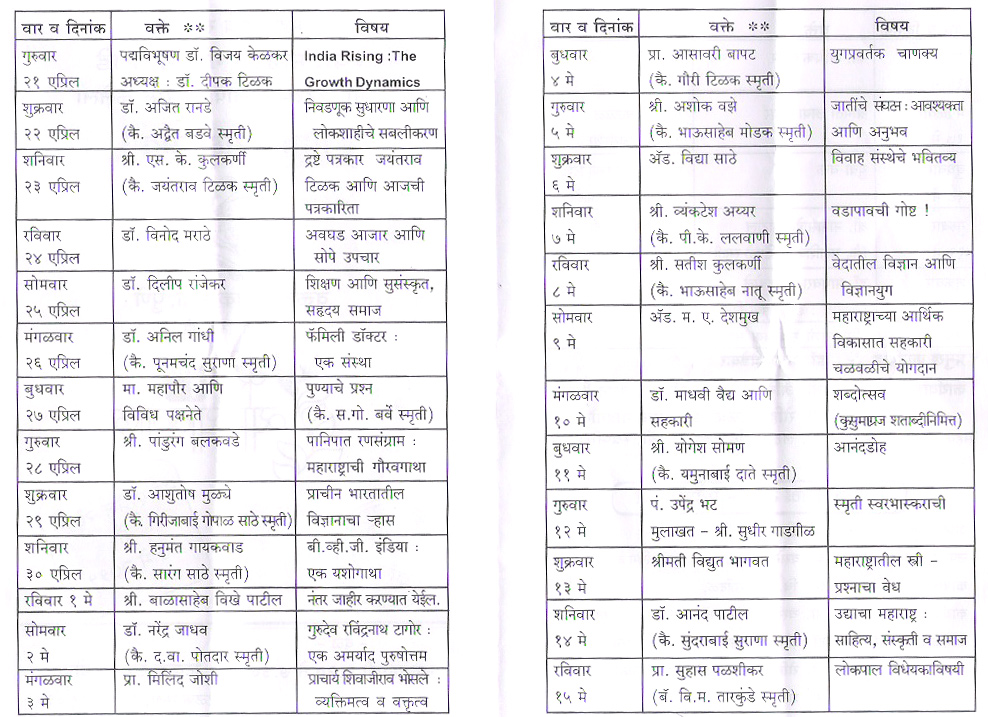
leave a comment